Match sod to sun and soil in North Andover: choose blends for shade and traffic, amend acidic Paxton soil, and install mid‑May to June.
Choosing the right sod for a lawn in North Andover, MA, requires careful planning. The area’s USDA Zone 6b climate and Paxton series soil present unique challenges, including acidity, poor drainage, and salt exposure from winter road treatments. Here’s a quick breakdown of what you need to know:
Proper sod selection and preparation ensure your lawn thrives despite North Andover’s tough soil and climate conditions.
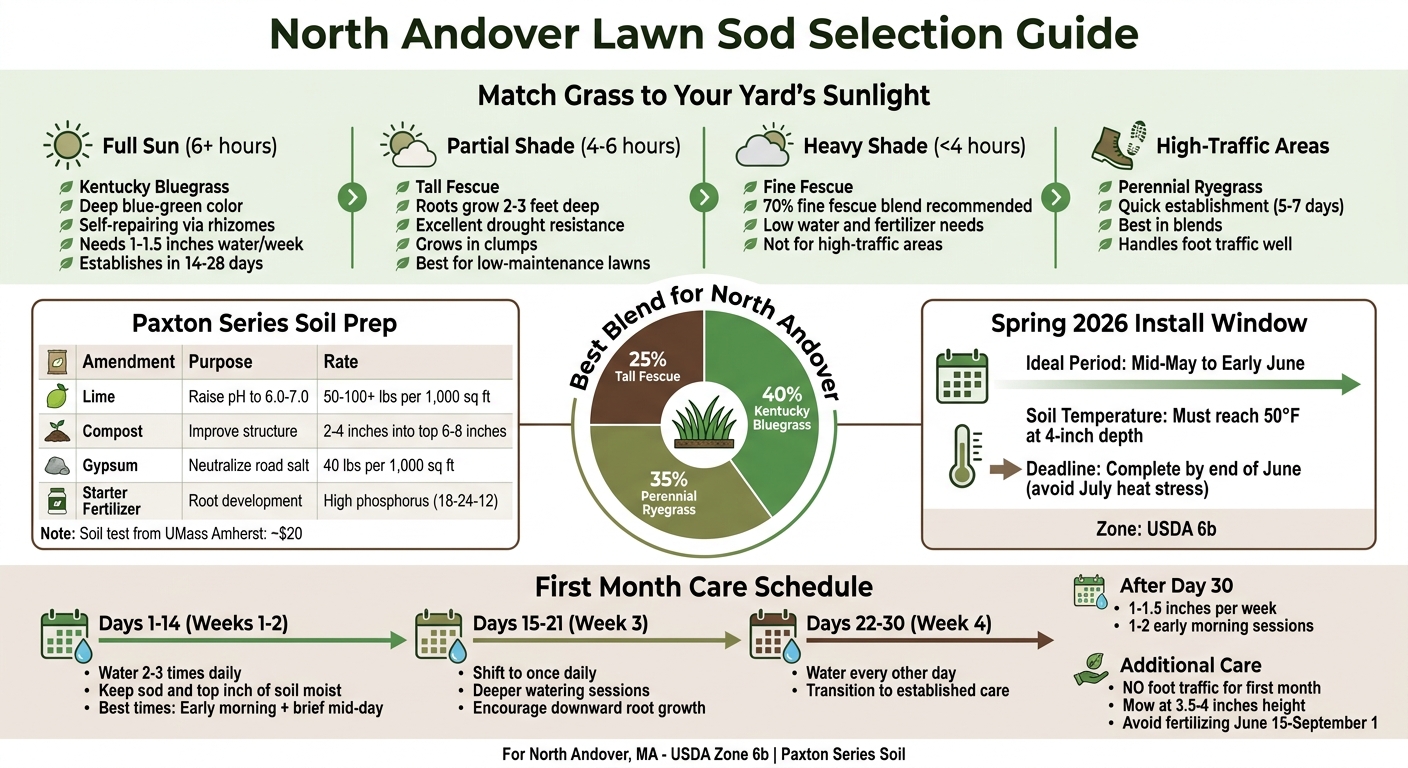
North Andover Sod Selection Guide: Grass Types, Soil Prep, and Care Schedule
Before reaching out to a professional sod installer, take some time to observe how sunlight moves through your yard. Check at three key times - 8:00 AM, noon, and 4:00 PM - to pinpoint areas with full sun, partial shade, or heavy shade. For instance, your front yard might bask in sunlight all day, while a side yard could stay shaded under large, mature trees. These observations will help you choose the right sod for each part of your yard.
For areas with less than four hours of sunlight, shade-tolerant sod like fine fescue is a great option. On the other hand, spots that get six or more hours of sunlight are ideal for Kentucky bluegrass or perennial ryegrass. If you have areas with partial shade, tall fescue or a mix of sod varieties will usually perform well.
When dealing with heavy shade from mature trees, a blend with about 70% fine fescue works best. If the shade is lighter and dappled, you'll have more flexibility with sod choices. Pay attention to areas where snow tends to linger longer - these tend to get less sun overall.
To make your job easier, label each part of your yard based on its light exposure: full sun, partial shade, or heavy shade. Then, match the sod accordingly - Kentucky bluegrass for sunny spots, tall fescue for partial shade, and fine fescue for heavily shaded areas. Properties in North Andover, for example, often require a mix of sod types across different zones, especially since the area's fine sandy loam soil can make it tricky to grow a single sod variety everywhere.
North Andover falls within USDA Zone 6b, meaning cool-season grasses are the go-to choice for lawns here. The climate and soil conditions in this area limit the options to certain grass varieties, each suited to specific parts of your yard.
The trick is pairing the right grass type with the right location. For instance, a sunny front yard calls for a different sod than a shaded side yard. That’s why most sod installation projects in North Andover rely on blended mixes. These mixes combine various grass types, ensuring the lawn thrives in areas with full sun, heavy shade, dry patches, or spots that hold moisture after rain.
Kentucky bluegrass is known for its deep blue-green color and thick, carpet-like texture that many homeowners love. It spreads through underground rhizomes, making it a self-repairing grass. However, it does require about 1 to 1.5 inches of water per week during the summer and takes around 14 to 28 days to establish.
Tall fescue stands out for its deep root system, which can grow 2 to 3 feet deep, giving it excellent drought tolerance compared to bluegrass. Its strong roots make it well-suited to North Andover’s fine sandy loam soil and reduce the need for constant care. This grass performs well in both full sun and partial shade. Unlike bluegrass, it grows in clumps rather than spreading, meaning it doesn’t repair bare spots as quickly. However, it excels during dry spells and hot summers.
"Tall fescue has overtaken Kentucky bluegrass as the grass of choice for Massachusetts homeowners who want a great-looking lawn without a golf course maintenance budget." - The Lawn Report
Perennial ryegrass is a favorite for its quick establishment, often sprouting in as little as 5 to 7 days. Its fast growth makes it ideal for blends, especially to provide quick green coverage while slower-growing grasses take root. It also handles foot traffic better than most cool-season grasses, making it perfect for play areas or paths. However, its winter hardiness and drought tolerance are lower than tall fescue, so it works best as part of a blend rather than on its own.
Fine fescue varieties - like creeping red, chewings, and hard fescue - are the top choice for heavily shaded areas. If parts of your yard, such as those under mature trees, get less than four hours of sunlight, fine fescue is your best option. It’s also low-maintenance, requiring less water, fertilizer, and mowing. However, fine fescue struggles in full sun and doesn’t hold up well to heavy foot traffic, so it’s best reserved for shaded, low-traffic zones.
Using a single grass variety across your yard often leads to uneven performance. For example, pure Kentucky bluegrass might thrive in sunny areas but fail in the shade, while fine fescue might do great under trees but wear out in high-traffic zones. Blended mixes address these challenges by combining the strengths of multiple grass types. This creates a lawn that can adapt to varying light, moisture, and traffic conditions.
"Think of mixes as a built-in insurance policy. If one species struggles one year due to unusual weather, others in the mix can step up and fill the gaps." - Sarah Mitchell, Lawn Diagnostics Specialist
A common blend for North Andover includes 40% Kentucky bluegrass, 35% perennial ryegrass, and 25% tall fescue. When you’re ready to start your sod installation, a local contractor can recommend a blend tailored to your yard’s layout. Just be sure to test and prepare your Paxton Series soil beforehand to ensure the best results.
Before you schedule sod placement, it's a good idea to send a soil sample to the UMass Amherst Soil Testing Lab. For about $20, you'll get detailed results on pH levels and nutrient needs specifically suited to Massachusetts soils. Aim to submit your sample in late winter or early spring so you’ll have the results in time for the mid-May installation period. Proper soil preparation is essential to ensure your sod stays healthy and looks great.
The fine sandy loam of North Andover, part of the Paxton series, is moderately well-drained but typically has a pH of 4.5–5.5. Since most cool-season grasses, like Kentucky bluegrass and tall fescue, thrive in a pH range of 6.0–7.0, you might need to adjust the soil. If your test shows a pH below 6.0, apply 50–100+ lbs of pelletized lime per 1,000 sq. ft. to bring it into the ideal range. Additionally, mixing 2–4 inches of compost into the top 6–8 inches of soil will improve both its structure and fertility, giving your grass a better foundation.
"Massachusetts soil pH ranges from 4.5 in some Berkshire County locations to 7.0 in the limestone‐influenced Connecticut Valley, so blanket recommendations are useless here." - The Lawn Report
For lawns near streets or sidewalks, salt from winter road treatments can be a problem. To mitigate this, apply 40 lbs of pelletized gypsum per 1,000 sq. ft. to help flush out road salt. Massachusetts uses around 700,000 tons of salt each year, which can harm soil structure and new grass roots. When installing sod, use a high-phosphorus starter fertilizer, like an 18-24-12 blend, to encourage strong root development. This is allowed under Massachusetts law during turf establishment. Lastly, don’t forget to contact Dig Safe at least 72 hours before you start any tilling or digging to ensure underground utilities are marked.
Here’s a quick summary of the key amendments and their recommended application rates:
| Amendment | Purpose | Recommended Rate |
|---|---|---|
| Lime | Raise pH to 6.0–7.0 | 50–100+ lbs per 1,000 sq. ft. |
| Compost | Improve structure/fertility | 2–4 inches into top 6–8 inches |
| Gypsum | Neutralize road salt | 40 lbs per 1,000 sq. ft. |
| Starter Fertilizer | Promote root development | High phosphorus (e.g., 18‑24‑12) |
In North Andover, the ideal window for spring sod installation runs from mid-May through early June. Even if the frost season ends a week or two earlier than usual, it's best to hold off until mid-May when soil temperatures consistently reach 50°F at a depth of 4 inches. This temperature is crucial for cool-season grasses, as it ensures rapid root development. The timing is tailored to the specific climate conditions of North Andover.
"Spring in Andover does not ease in - it arrives all at once. One week you are still watching snow melt off the driveway, and the next, the 'Spring Rush' is on." - T&B Landscaping
Although fall is generally better for root establishment due to warm soil and cooler air, many homeowners in North Andover opt for spring installations. Why? Spring provides an opportunity to repair damage from winter, such as salt exposure and snow mold. Massachusetts spreads around 700,000 tons of road salt each winter, leaving lawns near streets looking like salt flats by April. For these areas, spring sod installation is often the best solution.
Make sure to complete your spring sod installation by the end of June. Sod laid in July risks heat stress when temperatures climb above 80°F, forcing the grass into survival mode instead of promoting strong root growth. To keep your new lawn healthy, regular watering is essential to prevent dormancy during the warmer months. Also, consider applying a preventative grub treatment by early to mid-June, as fresh sod is particularly susceptible to Japanese beetle grubs in August.
During the first month after installing sod, it's crucial to keep the sod consistently moist. Avoid overwatering, but don’t let it dry out either.
For the first two weeks, water your sod 2 to 3 times daily in short sessions. This ensures that both the sod and the top inch of soil stay moist. Early morning is the best time to water, but a brief mid-day session during the hottest hours can help maintain moisture along the edges.
"Keep the seedbed consistently moist (not soaked) for the first 2-4 weeks. Light watering 2-3 times per day is better than one heavy soaking." - Sarah Mitchell, Lawn Diagnostics Specialist
By the third week (around day 21), shift to deeper watering sessions once daily. By day 30, reduce the frequency to every other day. These longer sessions will help water penetrate deeper into the soil, encouraging the roots to grow downward into the Paxton series soil. Once the sod is established, aim for 1 to 1.5 inches of water per week, ideally delivered in one or two early-morning sessions.
Avoid watering in the evening, especially during humid weather, as this can create conditions for fungal diseases.
While your sod establishes itself, avoid walking on it during the first month. Foot traffic can damage the tender roots and tear grass blades, leading to unsightly brown patches. If you need to access the area, use temporary walkways to minimize damage until the sod is firmly rooted.
If your sod installation coincides with rising summer temperatures, take extra precautions. Set your mower height to 3.5–4 inches to protect the roots and reduce evaporation. Avoid fertilizing between June 15 and September 1, as it can increase the risk of fungal diseases. For sod installed in late May or early June, the first summer heat will be a challenge. During drought conditions, water at least 0.5 inches every two weeks to keep the grass crowns alive, even if the blades go dormant.
Transforming your North Andover lawn into a thriving, lush landscape starts with the right approach. Success hinges on choosing grass varieties that match your yard's unique conditions. For instance, Kentucky bluegrass thrives in full sun, tall fescue handles partial shade or drought well, perennial ryegrass works best in high-traffic areas, and fine fescue excels in deep shade. Blends like a 50/50 or 60/40 mix of Kentucky bluegrass and tall fescue often outperform single-variety options in Zone 6b.
Soil preparation is just as crucial. With North Andover's Paxton series soil, adjustments like pH balancing and compost enrichment are key. A local soil test, such as the $20 analysis from the UMass Soil Testing Lab, provides precise lime and nutrient recommendations tailored to your area.
Timing your sod installation between mid-May and June gives your lawn the best start. Adhering to a 30-day watering schedule - 2 to 3 times daily for the first two weeks, followed by deeper, less frequent watering - helps the sod establish strong roots in the Paxton soil.
The first month is critical for long-term success. Avoid walking on new sod, keep your mowing height at 3.5–4 inches, and protect your lawn from July's heat stress. These steps, based on years of practical experience, ensure your lawn thrives in North Andover's climate from spring through late fall. By combining the right grass, proper soil preparation, and consistent early care, you can achieve a low-maintenance, beautiful lawn. For professional sod installation and other landscaping services, contact Oliver Enterprises for expert assistance.
For a yard in North Andover that gets both sun and shade, a blended sod mix works best. This mix typically combines tall fescue, which handles shade and drought well, with Kentucky bluegrass, known for its dense, self-repairing nature and preference for sunny areas. Together, they create a durable, even-looking lawn. In New England, blended sod generally outperforms single-variety options.
To achieve great results, make sure to prepare the soil thoroughly, maintain consistent watering, and keep foot traffic to a minimum for the first 30 days.
Before you begin, test your soil's pH and nutrient levels. If the results show it's too acidic, you can apply lime in the recommended amount to create a better environment for grass growth. To boost fertility and improve the soil's structure, mix in organic matter or compost. Clear away any debris, level the surface, and either lightly till or aerate the soil to enhance water and nutrient absorption. Once that's done, give the soil a good watering to help it settle, setting the stage for healthy sod installation and strong root development.
You can check if your sod has rooted by giving it a gentle tug after about two weeks. If it doesn’t lift easily, the roots have started to establish. Other signs include a healthy, green color and grass growth exceeding 3.5 inches. While some dryness or stress is normal at first, consistent watering and proper care will help your sod thrive during this early stage.