Plan retaining walls for North Andover slopes: assess soil, prioritize drainage, pick the right materials, and follow MA permit rules.
If you're dealing with steep slopes in North Andover, a retaining wall can stabilize soil, create usable outdoor spaces, and prevent erosion. However, the region's glacial subsoil, heavy rains, and harsh winters make proper planning essential to avoid costly failures. Here's what you need to know:
Proper design and expert guidance are key to building a retaining wall that withstands North Andover's challenging conditions. Keep reading for detailed steps, material comparisons, and local permit requirements.
Understanding your yard's unique features is key, especially in areas like North Andover, where glacial deposits, compacted subsoil, and uneven terrain are common challenges.
Start by determining the slope's steepness. Measure the vertical drop in feet as you walk from the top of the slope to the bottom. Then, measure the horizontal distance between these two points. Use these measurements to calculate the slope's grade and assess how steep it is.
Look for clues like soil erosion, water pooling, or muddy spots after storms - these often signal areas that might need a retaining wall with built-in drainage. If your slope has a grade steeper than 14%, consider consulting a professional to decide whether a tiered wall system or a single structure would work best for your yard.
Once you’ve evaluated the slope, the next step is to analyze the soil composition to ensure your retaining wall will remain stable.
North Andover’s soil is heavily influenced by glacial till - a dense, compacted subsoil left behind during the last Ice Age. While this type of soil offers a solid base, it has poor drainage. Rain and melting snow can accumulate behind a retaining wall, creating hydrostatic pressure that may cause the wall to bulge or fail if not properly addressed.
Additionally, the subsoil’s impermeable nature can lead to frost heaves in the winter. As trapped water freezes and expands, it can push against structures, causing sinkholes or uneven surfaces in your hardscape. To prevent these issues, retaining walls in North Andover often include advanced drainage systems. These systems typically feature perforated drain pipes, gravel backfill, and weep holes to control water flow and relieve pressure effectively.
Poor drainage, especially during spring snowmelt, can create hydrostatic pressure that leads to serious issues like bulging, leaning, or even the collapse of a well-constructed wall.
In areas like North Andover, where dense glacial subsoil is common, trapped water can freeze and expand. This process, known as frost heaving, shifts the wall’s foundation and may cause sinkholes. The problem worsens with repeated freeze-thaw cycles, making proper drainage essential.
"Improper drainage can lead to flooding, erosion, and long-term property damage, which often results in expensive repairs." - TJs Drainage Solutions
Here’s how gravel backfill and perforated drain pipes can help manage these challenges.
A well-installed gravel backfill is key to managing drainage and reducing stress on retaining walls. This creates a porous layer behind the wall, allowing water to flow downward instead of building pressure against the structure. Clean, angular crushed stone works best because its interlocking shape maintains the voids needed for water movement. Avoid mixing in soil or sand, as these materials can clog the drainage system and undermine its effectiveness.
Place a perforated drain pipe just above the footing at the base of the wall. This pipe collects water filtered through the gravel backfill and redirects it to a safe discharge point. To keep the system clear, wrap the pipe in filter fabric to block soil from entering. Ensure the pipe is installed with a slope of at least ¼ inch per foot, which encourages steady water flow. Direct the discharge to a suitable outlet, such as a drainage swale, dry well, or storm drain, to keep water away from the foundation.
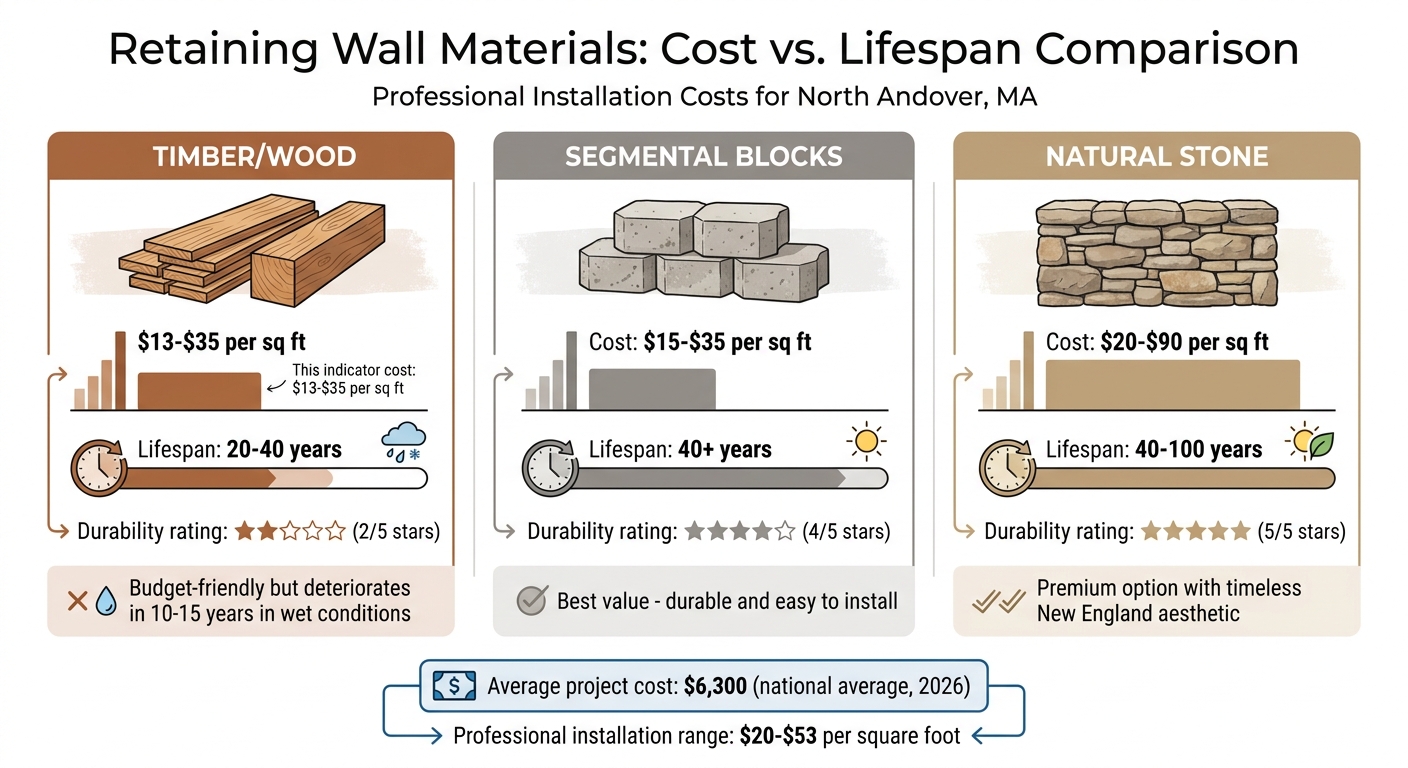
Retaining Wall Materials Cost and Lifespan Comparison
Once you've addressed drainage, the next step is picking a material that suits your design and can handle local conditions. The material you choose will directly affect both the cost and durability of your retaining wall, especially in North Andover's climate.
On average, professional installation costs range from $20 to $53 per square foot, with a national average project cost of $6,300 projected for 2026. However, your choice of materials can significantly influence the final price, depending on your property’s needs and your aesthetic preferences. Here’s a quick comparison of common options to help you decide:
| Building Material | Cost Per Square Foot | Typical Lifespan |
|---|---|---|
| Timber / Wood | $13 – $35 | 20 – 40 years |
| Segmental Blocks | $15 – $35 | 40+ years |
| Natural Stone | $20 – $90 | 40 – 100 years |
Segmental retaining wall (SRW) blocks are made of interlocking concrete units designed to endure tough weather conditions in North Andover. They offer excellent structural support against soil pressure. For taller walls, adding geogrid fabric can strengthen the soil and improve the wall's stability.
Products like Keystone blocks use interlocking pin systems, allowing for flexible installations - whether near-vertical or set back - making them adaptable to various slopes. They're quicker to install than natural stone, which can help reduce labor costs. With proper drainage, these walls can last over 40 years, even in North Andover's wet conditions and freeze-thaw cycles.
If you're aiming for a more refined appearance, natural stone might be your best bet. Its timeless look pairs beautifully with North Andover’s architectural style. For instance, Cathie B., a local homeowner, shared her experience after hiring Oliver Enterprises in 2026 to replace her wall:
"We are especially impressed with how beautiful the new wall is and how it seamlessly blends into the old wall."
Natural stone is a premium option, with costs ranging from $20 to $90 per square foot. This reflects both the expense of the material and the skilled craftsmanship required. Contractor Devin Devine highlights that dry stone walls, in particular, take significantly more time to construct, but their durability makes the investment worthwhile. Properly built, these walls can last between 40 and 100 years. A key technique is incorporating a "batter", which means angling the wall back into the slope. This design uses gravity to maintain long-term stability, even in North Andover’s challenging climate.
For those looking to save on upfront costs, timber is a quicker and more affordable choice. Pressure-treated lumber is especially fast to install. However, timber doesn’t hold up well to North Andover's wet conditions and freeze-thaw cycles. While timber walls can last 20 to 40 years under ideal circumstances, many begin to show rot and deterioration within 10 to 15 years in areas with poor drainage or heavy spring snowmelt.
To improve stability, contractors often use "dead men", which are timber beams extending into the hillside, and secure the base with rebar. Even with these reinforcements, timber remains the least durable option and will likely need replacement far sooner than segmental or stone walls.
In Massachusetts, understanding the permit requirements for retaining walls is crucial. The measurement of wall height includes the buried footing, which often pushes the total height beyond the 4-foot threshold.
According to Massachusetts 780 CMR regulations, retaining walls that are 4 feet or taller require both a permit and professional engineering approval. Importantly, the height is measured from the bottom of the footing to the top of the wall - not just the visible portion above ground.
"The 2012 International Building Code requires a permit for retaining walls over 4' in height, measured from the bottom of the footing to the top of the wall – not measured by exposed wall."
– Landscape Architect Network
For instance, a wall that appears to be only 3 feet tall above ground might actually measure between 4.5 and 5 feet when the footing - typically extending 12 to 18 inches below ground - is included. Additionally, even walls under 4 feet may still require permits if they support extra loads, such as driveways, fences, or steep slopes. Properties located within 100 feet of wetlands or 200 feet of a river may also need additional reviews from the local Conservation Commission or the Department of Environmental Protection.
These strict measurement standards highlight the importance of expert evaluation.
Given the detailed requirements, professional engineering is essential for obtaining the necessary permits. The application must include a structural plan created by a licensed engineer, architect, or qualified contractor. This plan should address critical aspects such as the wall's stability, drainage, and ability to support loads. Additionally, a plot plan showing the wall's exact location and dimensions is required to ensure compliance with zoning setbacks, which typically range from 15 feet for side lots to 50 feet for front lot lines in residential areas.
Collaborating with a professional contractor familiar with local regulations can streamline the process of securing approvals from various authorities, including the Building Commissioner and, if applicable, the Board of Health (especially for properties with septic systems). This upfront investment not only ensures compliance but also helps avoid costly mistakes or structural issues later. Following these standards is essential for building a retaining wall that can endure Massachusetts' challenging weather conditions.
Spotting problems early can save you from expensive repairs later. In North Andover, the freeze-thaw cycles and spring snowmelt create unique challenges for retaining walls, making regular inspections - especially after winter - absolutely necessary.
If your wall is bulging, bowing, leaning, or tilting, it’s a clear sign that hydrostatic pressure and lateral soil loads are pushing the wall beyond its limits.
Take a close look at the soil behind the wall. Displacement or sinkholes can indicate deeper problems. For instance, one customer of Brouder & Sons shared:
"Chipmunks (tunneling underneath) and frost heaves had caused a sink hole and general unevenness".
These sinkholes often result from frost heave, which can shift and lift the wall’s foundation, causing instability.
Cracks are another warning sign, especially if water is actively seeping through them or at the wall–floor junction. According to Low Point Labs, hydrostatic pressure can force water through the foundation, highlighting the need for proper drainage systems. You might also notice white mineral deposits, known as efflorescence, on the wall’s surface. This is a telltale sign that water is repeatedly moving through the masonry.
Most of these structural issues trace back to drainage problems, which are discussed in the next section.
Improper drainage is the leading cause of retaining wall failures in this area. After a 1-inch rainfall, check if water is still pooling after 24 hours. If it is, that’s a sign of poor drainage.
Look at the soil behind the wall - if it has settled into a "moat" shape, directing water toward the structure, it could be setting the stage for failure.
Also, inspect weep holes and drainage outlets to ensure they’re not clogged with debris or soil. Don’t forget to check gutters and downspouts - they should discharge water at least 6 feet away from the wall to prevent oversaturation of the soil nearby.
These issues tend to surface during the March to May snowmelt season when the soil is often saturated. If you notice any of these problems, it’s best to contact a retaining wall contractor for a professional evaluation before minor issues escalate into major structural damage.
Retaining wall contractors bring together site evaluation and engineering skills to create solutions tailored to North Andover's specific landscape challenges. For example, structural walls on steep slopes require careful engineering to counteract soil pressure and prevent shifting.
Getting a contractor involved early can make a big difference. It's best to contact a retaining wall contractor right at the beginning of your planning process. Take the case of Andrew E., who hired Oliver Enterprises in May 2026 to tackle a tricky North Andover property with a yard that sloped 7 feet in less than 50 feet. The team installed stone retaining walls and two staircases, expertly fine grading the area to transform what Andrew called a "muddy mess" into a functional lawn.
"The crew expertly fine graded the site to create usable lawn space, patios and stairs that mesh into the existing structures beautifully."
- Andrew E., Creative Director
Professional contractors also handle critical technical aspects like drainage design, which prevents wall failure caused by hydrostatic pressure. They take care of the necessary permits and engineering approvals required for walls taller than 4 feet (measured from the footing to the top), ensuring compliance with Massachusetts safety standards and avoiding costly delays or penalties.
For North Andover, where glacial subsoil and spring snowmelt present unique challenges, hiring local experts can safeguard your investment. Properly designed walls are key to avoiding drainage issues that are common with poorly constructed projects. Oliver Enterprises, for instance, has earned a 4.9/5 rating from over 150 customer reviews, with clients frequently applauding their ability to overcome unexpected site challenges and deliver durable results. Starting your project with skilled contractors can turn even the steepest slopes into functional, lasting landscapes.
When dealing with a sloped yard, creating multiple tiers is often a smarter choice than constructing a single tall wall. Tiers enhance stability, minimize the chance of structural issues, and help with drainage - especially important in areas like North Andover, where spring snowmelt and uneven terrain can pose challenges. Plus, walls taller than 4 feet (measured from the footing to the top) usually require permits and precise engineering. Opting for tiers not only avoids these complications but also tends to look better overall.
Properly directing the drain pipe outlet for a retaining wall is crucial to protect both the wall and the surrounding property. The outlet should guide water away from the wall and any structures to avoid potential flooding or damage. The best approach is to route the water to a suitable location, such as a dry well, a storm drain, or another area capable of managing the water flow effectively. This setup helps reduce hydrostatic pressure behind the wall, which is essential for maintaining its stability over time.
Retaining walls under four feet might seem straightforward, but they can still require an engineer’s expertise if they handle additional pressures like steep slopes, driveways, or building foundations. In North Andover, the combination of glacial terrain and spring snowmelt often leads to hydrostatic pressure, making professional evaluation especially important. If your wall bears extra weight, sits on a slope, or you’re uncertain about its stability, reaching out to an engineer is a smart move to ensure both safety and compliance.