Budget $1,000–$6,500 for most Massachusetts French drain projects. Plan $10–$65/ft; final cost varies with depth, soil, access, permits, outlet & restorati
Budget $1,000–$6,500 for most residential French drain projects in Massachusetts. For a starting estimate, use $10–$30 per linear foot for basic exterior drainage work or $30–$65 per linear foot for complex installs. These are planning ranges, not quotes.
Final cost depends on drain type, length, depth, soil conditions, equipment access, discharge location, and landscape repairs. The backyard drainage problem guide goes deeper on how site conditions shape the scope. Interior basement drains need a separate estimate. Concrete removal and replacement add significant work.
Before hiring a contractor, get the full scope in writing:
Use the cost breakdown below to compare estimates before requesting a site evaluation for your drainage and restoration work.
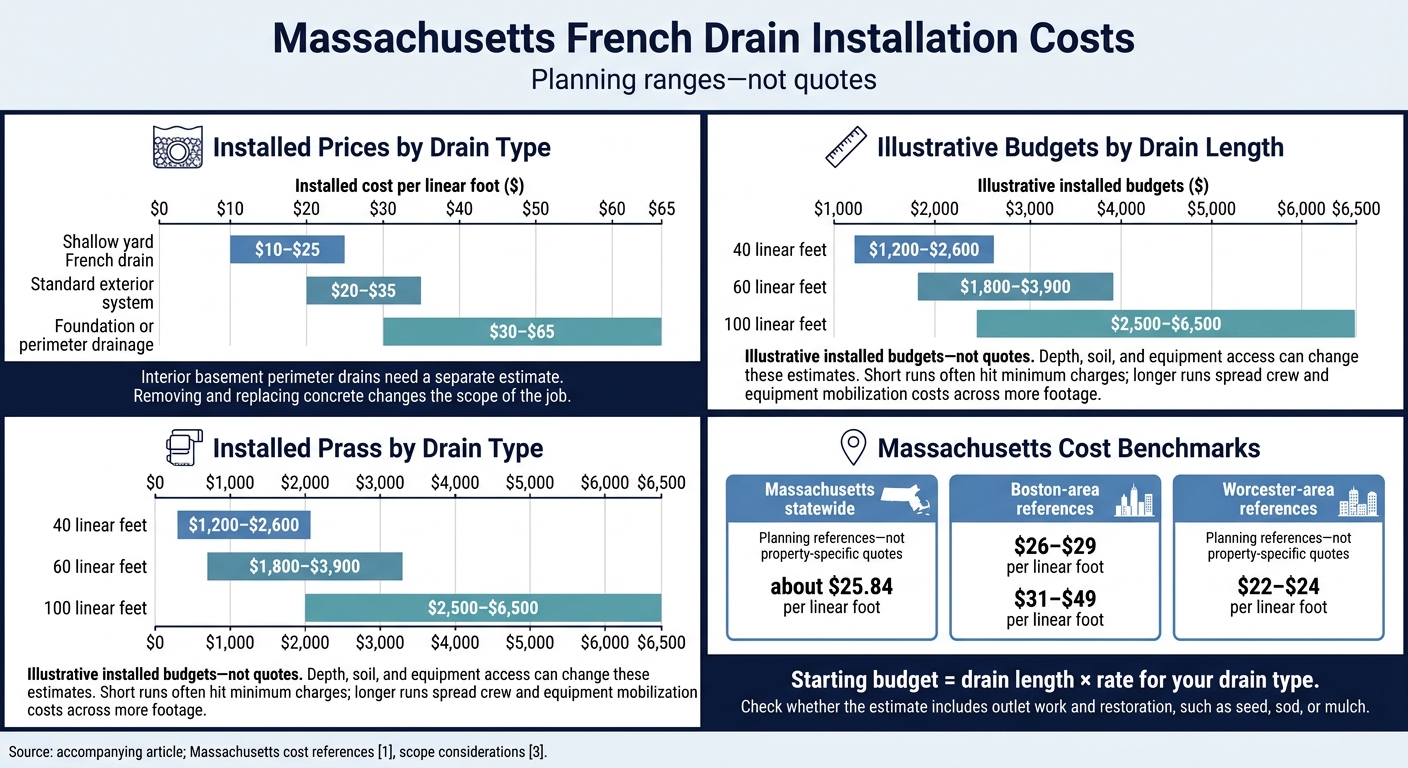
Massachusetts French Drain Installation Costs
Start your budget with the drain type, then factor in length. Depth and excavation drive much of the cost.
| Drain Type | Installed Cost per Linear Foot |
|---|---|
| Shallow yard French drain | $10–$25 |
| Standard exterior system | $20–$35 |
| Foundation or perimeter drainage | $30–$65 |
Interior basement perimeter drains need a separate estimate. Removing and replacing concrete changes the scope of the job.
Depth, soil, and equipment access can change these estimates. Short runs often hit minimum charges, while longer runs spread the cost of bringing crews and equipment to the site across more footage.
Budget examples
Drain Length Illustrative Installed Budget 40 linear feet $1,200–$2,600 60 linear feet $1,800–$3,900 100 linear feet $2,500–$6,500
Multiply the length by the rate for your drain type to get a starting budget. The final price may not increase evenly with each foot. Check whether the estimate includes outlet work and restoration, such as seed, sod, or mulch.
Massachusetts planning references put drainage work at about $25.84 per linear foot statewide. Boston-area references list $26–$29 and $31–$49 per foot, while Worcester-area references list $22–$24.
Use these figures as benchmarks, not as a quote for your property. A site-specific estimate accounts for the actual grade, soil conditions, and drainage needs.
Two projects with the same footage can cost different amounts because of site conditions. Simple sites usually fall near the lower end of the earlier budget ranges. More difficult sites can push costs higher.
Price the site conditions - not just the footage. Longer or deeper trenches mean more labor, excavated soil to remove, and restoration work. Site assessments should also account for clay or rocky soil, plus limited equipment access around fencing, irrigation systems, and established plantings.
The table below separates confirmed work from conditions that still need assessment, starting with factors that can affect the price before digging begins.
| Price Factor | Effect on Installation | Budget Effect |
|---|---|---|
| Length and depth | Determines excavation, materials, and excavated soil removal | Confirmed once dimensions and disposal scope are agreed |
| Soil conditions | May require different excavation methods or more labor | Site-dependent allowance until conditions are assessed |
| Equipment access | May require coordination around fencing, irrigation, or plantings | Confirmed if planned; allowance if unresolved |
| Discharge and approvals | Adds outlet work, utility coordination, and permit review | Confirmed outlet costs and applicable fees; allowance for unresolved requirements |
| Landscape repairs | Adds sod, planting, mulching, or masonry work | Confirmed for specified repairs; allowance until restoration scope is finalized |
Use allowances only for unresolved conditions.
Set the discharge plan before excavation and include outlet work in the written scope. Check local excavation rules, too. Some Massachusetts towns, including Arlington, Cambridge, and Lexington, require permits for this work.
| Drainage Problem | Design to Evaluate | Scope to Confirm |
|---|---|---|
| Standing water in lawn areas | Yard French drain | Drain route and discharge location |
| Moisture near the foundation | Site-specific perimeter drainage evaluation | Water source and foundation conditions |
| Patios or walkways disturbed by sitework | Patio or walkway repair | Repair scope and finished surface restoration |
Specify sod, planting, mulch, masonry, irrigation, and fencing repairs in the estimate so the price includes restoration. Before work starts, list each site condition and repair item on its own line in the written quote.
Once you know the likely price range, review the written quote line by line.
Compare the full scope - not just the per-foot price. The quote should specify the drain length, trench width and depth, pipe size and type, gravel, filter fabric, and discharge location. Ask for any missing details.
Check that the estimate lists:
With the scope clear, compare how each contractor handles allowances and extra charges.
Separate fixed costs from costs that depend on site conditions. Mark each item as included, excluded, or allowance-based, and identify who coordinates excavation, drainage work, and restoration.
| Scope Status | What the Quote Should State | Details to Check |
|---|---|---|
| Included | Work covered by the base price | Excavation, materials, backfill, outlet work, and finishing |
| Excluded | Work outside the quoted total | Whether pumps, dry wells, excess-spoil hauling, or additional repairs need separate pricing |
| Allowance-based | A stated budget for unresolved work | Dollar amount, pricing basis, and how unused funds or overruns are handled |
Require written approval before extra work starts. For ledge, groundwater, extra disposal, or discharge equipment, the change order should explain the reason and added cost. Ask whether pricing uses a fixed amount, hourly rates, or measured quantities.
Confirm that the contractor is fully insured and provides a written, itemized estimate. The quote should also include a final walkthrough and punch-list review, with details on how drainage performance will be checked.
Budget $10–$30 per linear foot for basic exterior drainage installation and $30–$65 per linear foot for complex work. Most residential projects land between $1,000 and $6,500.
Start with the per-foot range, then adjust for depth, excavation conditions, access, discharge, and landscape restoration. Include sod and planting restoration in the scope before work begins. Those line items drop out of early budgets more often than they should.
Oliver Enterprises scopes drainage work across North Andover and the Merrimack Valley by tying drainage and restoration costs together before a written estimate goes out. Get the full scope in writing before signing: materials, excavation, outlet work, cleanup, and landscape repairs. The backyard drainage guide covers how Massachusetts contractors diagnose site conditions and build the scope from evaluation forward.
Check your property during and after heavy rain. Water pooling for more than 24 hours, muddy spots that don’t dry out, or spongy turf are signs of poor drainage.
The USDA Web Soil Survey can help identify your soil’s drainage class and layers that limit downward water flow. These layers, such as compacted glacial till or bedrock, force water sideways instead. A professional site assessment is the most reliable way to confirm your drainage needs, because conditions vary from one location to another.
Set aside 10%–20% of your French drain project cost for unexpected soil or excavation conditions. That cushion can cover tougher digging, deeper excavation, additional base work, extra drainage, or site restoration.
Ask for an itemized quote that clearly covers excavation details, drainage work, and cleanup/restoration. This helps you spot missing work before installation begins.
Yes. Massachusetts experiences 30 to 40 freeze-thaw cycles each year. When trapped water freezes, it expands by approximately 9%. That expansion can cause frost heaving, shifting, or structural damage.
A properly installed French drain helps reduce these risks by directing excess groundwater to a safe discharge point before it collects and freezes. The design must account for local soil conditions, and the discharge outlet must stay clear of debris and ice.