Stone steps in Massachusetts: compare granite, bluestone, fieldstone and precast; key tips on frost‑depth footings, drainage, permits, winter wear, and cos
If you live in Massachusetts, stone steps usually last longer when the build starts with frost-depth footings, solid drainage, and the right stone - not just the lowest bid.
Your biggest cost drivers are often base prep, step count, and site access. For many homes, granite is the safest pick for heavy use and road salt, while bluestone, brownstone, fieldstone, and precast concrete each fit different budgets and looks. Local permit records in Arlington and Lexington show projects from $7,375 to $16,000, with price changes tied to labor, layout, and excavation.
Before choosing a material, you should focus on:
A fast way to think about it: if your steps handle daily traffic and winter salt, durability often matters more than upfront price. If your steps are tilting, sinking, or pulling away, the problem may be below the surface, which often points to replacement instead of a surface fix.
Quick Comparison
| Material | Upfront Cost | Cold-Weather Wear | Salt Handling | Upkeep | Best Use |
|---|---|---|---|---|---|
| Granite | High | Strong | Strong | Low | Main entry steps |
| Bluestone | Medium | Good with sealing | Mid-range | Medium | Entries and patios |
| Brownstone | High | Lower | Lower | High | Older home restorations |
| Fieldstone | Varies | Good | Mid-range | Medium | Garden and slope steps |
| Precast Concrete | Low | Lower | Lower | Medium | Budget stoops |
The rest of the article breaks down how site conditions, stone choice, and winter exposure shape both price and long-term repairs.

Once you know which type of step you need, the next thing to sort out is the site itself. Slope, soil, drainage, and how the steps tie into the house all affect footing depth and permit rules. In plain English: those job-site details shape the build first. Material comes after that.
A solid base starts with excavation and compacted gravel so water can drain away. For structural front-entry stairs, that usually means a concrete footing placed below the frost line. Structural stairs need below-frost footings and drainage that keeps water from pooling under the base.
Winter changes the game in Massachusetts. Stair pitch and drainage need to account for snow and ice so meltwater doesn’t sit on the steps or freeze again later.
Permit rules can change from one town to the next, and front-step replacement or major additions often need review before work starts. If the front steps are treated as part of the primary egress route, that can trigger formal review before construction begins. Check with your local building department before construction.
With code and footing rules pinned down, material choice becomes the next cost and performance decision.
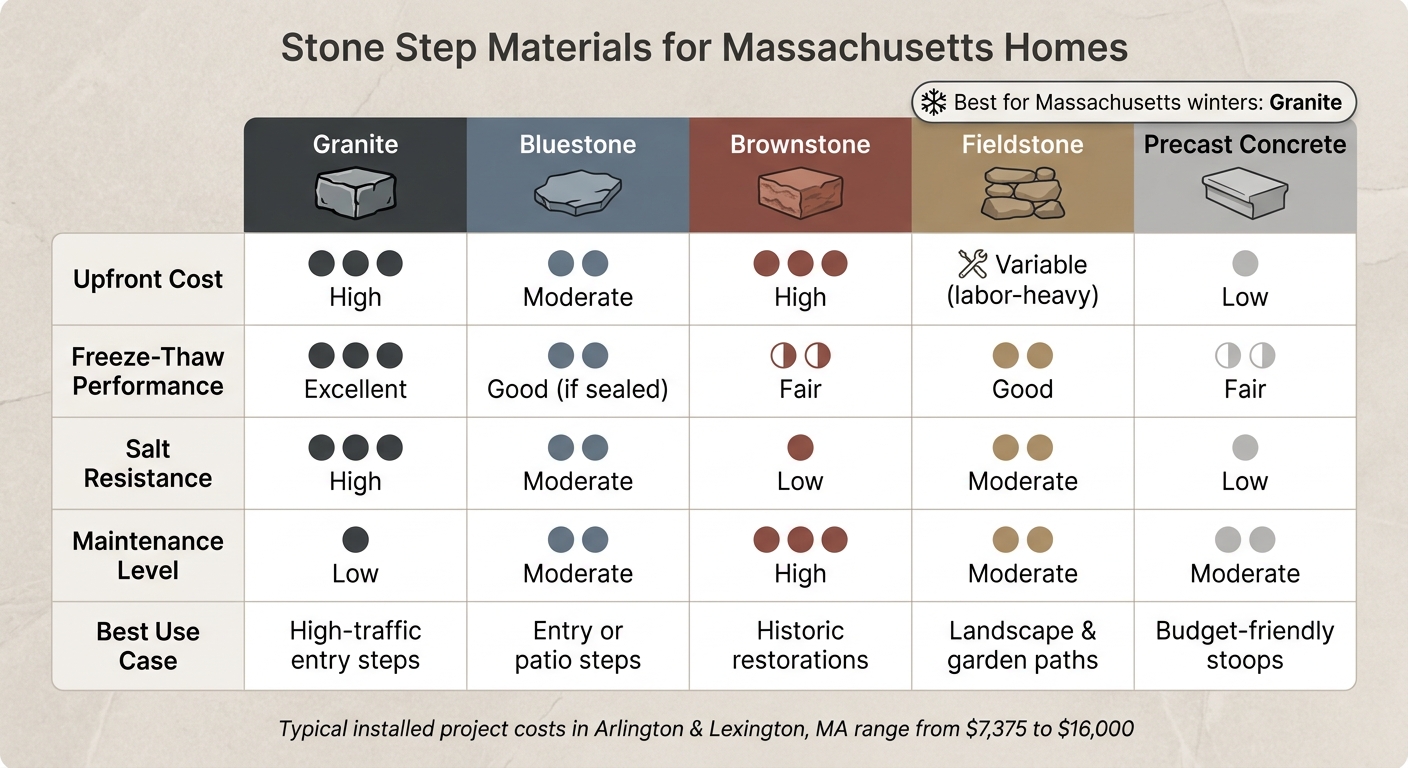
Stone Step Materials Compared: Cost, Durability & Salt Resistance in Massachusetts
Material choice shapes how long your steps last, how much upkeep they need, and how they look day to day. In Massachusetts, that choice also comes down to salt, freeze-thaw swings, and how much foot traffic the steps need to handle. Price can move up or down based on riser count, material grade, site access, and base prep.
The table below gives the fastest side-by-side comparison.
| Material | Relative Installed Cost | Freeze-Thaw Performance | Salt Resistance | Maintenance Level | Aesthetic Character | Best-Fit Use Case |
|---|---|---|---|---|---|---|
| Granite | High | Excellent | High | Low | Formal, speckled, uniform | High-traffic entry steps |
| Bluestone | Moderate | Good (if sealed) | Moderate | Moderate | Classic blue-gray, layered | Entry or patio steps |
| Brownstone | High | Fair | Low | High | Historic, reddish-brown | Historic restorations |
| Fieldstone | Variable, labor-heavy | Good | Moderate | Moderate | Natural, rustic, irregular | Landscape and garden paths |
| Precast Concrete | Low | Fair | Low | Moderate | Uniform, practical | Budget-friendly stoops |
Granite is the top performer for front-entry steps in Massachusetts. It stands up well to heavy foot traffic and deals with deicing salt better than most common step materials.
Bluestone is common on New England stoops and walkways, and its blue-gray tone works well with many homes. But there’s a catch. Bluestone is more porous than granite, which means water and salt can get into the surface more easily. If it isn’t sealed on a regular schedule, deicing salts can sink in and speed up flaking as freeze-thaw cycles repeat through winter.
That’s why bluestone makes more sense when you also plan for sealing and careful ice melt use. Skip that part, and the stone can wear down faster than many homeowners expect.
If the main goal is restoration or a more natural look, appearance starts to matter more than raw durability.
Brownstone is a good fit for historic restoration work when matching the original material matters. The downside is its weak spot in salt-and-moisture conditions. Erosion, flaking, and spalling are common when brownstone faces winter deicers without steady protective treatment.
Fieldstone leans in a different direction. It has an informal look, with irregular shapes that fit slopes, garden paths, and natural-style landscapes much better than a formal front entry. Labor is a major part of the cost here because each stone takes more time to fit and set than a uniform slab.
When upfront price is the main concern, precast concrete is usually the simplest path.
It works well for straightforward stoop replacements or budget-led projects. Installation is often faster, and the starting cost is usually lower than natural stone. The tradeoff shows up over time. Precast concrete is more likely to scale and spall when deicing salts keep soaking into the surface over several winters.
For a main entry that gets daily use and regular salting, granite usually gives better long-term value.
Once you’ve settled on the stone and frost-depth rules, the next big cost drivers are usually layout, site access, and base prep. In plain terms: after material choice, the shape of the job and how easy it is to build often matter more than the stone itself.
A small front stoop with two or three risers is nothing like a longer set of steps running down a sloped yard. The scope changes fast.
Wider steps cost more because they need more stone and more time to install. Landings and extra-wide runs also add to material, labor, and excavation. And layout isn’t just about looks. The steps should feel good to walk on, fit the house, and connect cleanly to a walkway, patio, or slope.
Those choices show up fast in the budget, especially in labor, digging, and permit-related costs.
In many cases, riser count, site access, and base prep have more impact on price than stone grade alone. If a crew has to tear out old steps, haul away debris, and excavate down to frost depth, a lot of the work happens before the first stone goes in.
Permit data from Arlington and Lexington shows just how much pricing can swing. A standard front steps project came in at $7,375. A stone step replacement at 24 Fairoaks Drive in Lexington, with the same dimensions kept in place, was valued at $12,000. A stone stair installation at 168 Cedar Ave in Arlington was listed at $13,000. On the high end, replacing two sets of brick stairs at 50 Lockeland Ave in Arlington reached $16,000.
| Project Type | Location | Estimated Cost |
|---|---|---|
| Front steps installation | Arlington, MA | $7,375 |
| Stone step replacement (same dimensions) | Lexington, MA | $12,000 |
| Stone stair installation | Arlington, MA | $13,000 |
| Replace 2 brick stair sets | Arlington, MA | $16,000 |
If equipment can’t get close to the work area, the crew may need to move stone by hand. That alone can add a chunk of labor time. The same goes for the base. If what’s under the old steps is failing, rebuilding it below the frost line can add cost that doesn’t jump out in an early quote.
The cheapest starting price doesn’t always lead to the lowest total spend. In Massachusetts, granite often makes more sense over time because it tends to hold up better under heavy foot traffic and rough weather. That tradeoff starts to matter once maintenance and repair costs enter the picture.
In Massachusetts, winter upkeep has a big effect on how long stone steps last.
The type of stone you choose affects maintenance, but winter weather changes how fast that stone breaks down. Deicing salt speeds up surface wear, especially when steps go through repeated freeze-thaw cycles. That’s where a lot of the damage starts.
Bluestone and other porous stones tend to wear out faster when they’re left unsealed. Granite holds up best in high-traffic areas and places that get a lot of salt. If you have bluestone or another salt-sensitive stone, sealing it before winter can help cut down on damage.
When stone steps start to fail, the main question is simple: surface damage, or base movement? That distinction matters.
Hairline cracks, small chips, and loose joints can often be fixed. Widespread movement, leaning, or uneven settling usually points to base failure, not surface wear. In that case, the fix goes below what you can see. The footing, backfill, and drainage need to be rebuilt below frost depth.
Permit records from Arlington and Lexington show that major step work is often handled as full remove-and-replace projects. Oliver Enterprises follows that same approach on North Andover jobs where base failure is the actual problem. The masonry repair guide covers those warning signs in more detail.
Major structural work can trigger local review. Before starting big step repairs, check whether your town requires a permit. Even replacing steps with the same size and layout can still trigger review. The new build should account for frost depth, drainage, and seasonal soil movement. A hardscaping consultation is usually where those site and permit questions get sorted out before work starts.
If granite fits your budget, it remains the most forgiving choice in Massachusetts weather over time.
Stone steps in Massachusetts can last for decades if they’re built on a properly prepared base that can handle the state’s freeze-thaw cycles. That usually means footings extend about 48 inches below grade to help prevent frost heaving.
When the base is solid, drainage is handled well, and the stone is the right fit for the job, these steps often last 25–50 years or more. But if base prep is rushed or frost-depth rules are ignored, shifting and cracking can cut that lifespan short.
Avoid sodium chloride (rock salt). It can speed up surface damage on natural stone and concrete.
A safer pick is calcium chloride or magnesium chloride, which are gentler on stone surfaces.
Yes. In many cases, existing steps can be rebuilt, and small areas of damage may be fixed.
The best path depends on how much damage is already there from problems like frost heave or hydrostatic pressure. If the foundation doesn't meet the Massachusetts rule that footings must extend at least 48 inches below the surface, the steps may keep shifting or cracking. In that case, a full rebuild with proper base prep and drainage is often the better long-term fix.