Massachusetts hardscapers diagnose yard pooling and choose drains, dry wells or permeable pavers based on soil, slope and outlet.
If water sits in your yard for more than 24 to 48 hours, the fix is usually not “more slope.” In Massachusetts, backyard drainage often comes down to four things: grade, soil, water source, and outlet.
If your lawn stays spongy, your patio edges hold runoff, or snowmelt turns the yard into mud, the right fix depends on where the water starts and where it can go. In Merrimack Valley soils like Paxton fine sandy loam, water may drain near the surface but slow down around 26 to 30 inches below grade. That’s why contractors often choose systems that collect, move, store, or slowly drain water instead of relying on the ground to absorb it.
Here’s the short answer for homeowners:
| Drainage issue | Usual fix | What to watch for |
|---|---|---|
| Wet turf or shallow subsurface water | French drain | Water may need a daylight outlet because lower soil drains slowly |
| Runoff over patios or walkways | Channel drain | Drain must be sized for heavy rain and spring melt |
| Roof water from downspouts | Dry well | Can fill too fast if the soil below drains slowly |
| Hardscape runoff over a large surface | Permeable paver field | Joints can clog faster in soils with more silt and clay |
The main point is simple: pooling is the symptom, not the diagnosis. A drainage plan works best when the contractor checks the slope, tests the soil, maps the flow path, and confirms a safe outlet before picking the system.
Before they suggest any system, contractors look at the site itself. They check the grade, the soil, and where the water can leave the property. In places with Paxton soils and spring snowmelt, that step matters a lot. A yard can look simple on the surface, but water often tells a different story once it starts moving.
That early diagnosis shapes the whole plan. If the cause is wrong, the fix will be wrong too.
Contractors usually begin by studying the slope of the property and spotting low areas where water tends to collect. Grade checks and survey tools help them see how runoff moves across the site. From there, they mark the main flow paths, ponding zones, and erosion points on a site map.
They also size the system based on the catchment area and expected storm intensity. That matters because a small problem during light rain can turn into a mess during a heavy storm.
Once surface flow is mapped, contractors move below grade to see how the soil handles water. Field soil checks help them figure out whether infiltration is a fit or whether the ground drains too slowly.
Paxton soils often hold water, so infiltration testing gets extra attention, especially during snowmelt season. If the soil can’t absorb water at a fast enough rate, the plan changes. Instead of sending water into the ground, the design shifts toward collection or conveyance.
The last step is figuring out where runoff enters the site and where it can discharge without causing another problem. Contractors look at entry points, outlet locations, and limits such as utilities, property lines, and stable discharge points.
Once they know the source, the flow pattern, and the outlet, they can match the drainage problem to the system that fits the site.
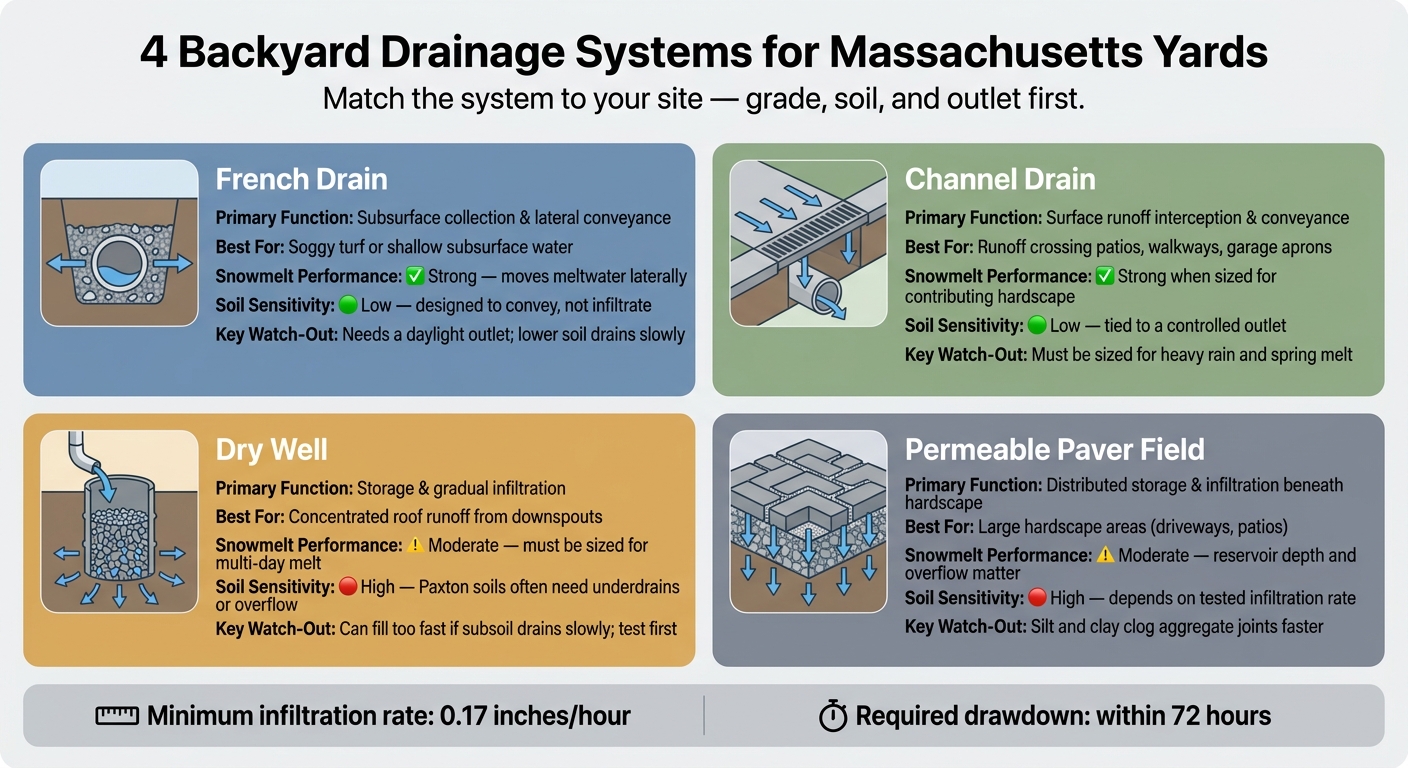
4 Backyard Drainage Systems: Which One Fits Your Massachusetts Yard?
Once the water path is clear, the contractor matches the system to the actual problem. The main issue is function: does the site need to collect water, move it, hold it, soak it into the ground, or do some mix of those jobs? That diagnosis cuts the options down fast.
| Drainage Pattern | Best System | Key Limitation on Paxton Soils |
|---|---|---|
| Soggy turf or shallow subsurface water | French Drain | Restrictive layers limit vertical infiltration, so water has to move laterally to a discharge point |
| Surface runoff across patios or walks | Channel Drain | Requires precise grading and can be overwhelmed by rapid snowmelt if not sized correctly |
| Concentrated roof runoff from downspouts | Dry Well | Slow-draining dense subsoil can cause drawdown to lag; infiltration testing is essential |
| Large-scale hardscape runoff across driveways or patios | Permeable Pavers | High silt and clay content can clog the aggregate joints faster |
Below grade, the choice usually comes down to four jobs: collection, conveyance, storage, or infiltration.
A French drain makes sense when water sits in turf or planting beds and the soil can’t move it downward fast enough. Instead of forcing water deeper into slow-draining subsoil, the system collects it at a shallow depth and moves it sideways to a lower-grade area or another discharge point.
That matters when a restrictive layer sits close to the surface. In that case, lateral movement is the practical fix. The system works with the soil conditions instead of trying to outmuscle them. That’s why French drains show up so often in North Andover and nearby towns where these soils are common.
Surface runoff is a different animal.
Channel drains handle surface water. More specifically, they intercept the water that runs across a patio, driveway, or walkway before it spreads or ponds.
Sizing matters here more than many homeowners think. During a heavy spring snowmelt in Massachusetts, water volume across a patio can jump in a hurry. If a channel drain is undersized, it can pond or spill over the top. Contractors plan for that when they size the drain and pick a grate that can stay clear of ice and debris.
When the source is a roof downspout or a new hardscape, the next question is whether the site needs storage, infiltration, or both.
Dry wells are a storage-first option. They work best for concentrated roof runoff from downspouts, where one defined source of water needs a place to go. But in slow-draining subsoil, a dry well only works if testing shows the soil around it can absorb the stored water. Dense subsoil, including glacial till common in this region, can make a dry well fill and overflow during a heavy storm if that step gets skipped.
Permeable paver fields work in a different way. Instead of collecting and moving water after it lands, they let water pass through the surface into a stone reservoir base below the pavers. There, the water is held for a time and infiltrates slowly. This setup fits sites where drainage needs to be built right into the hardscape. The downside on this kind of restrictive layer is simple: high silt and clay content can clog the aggregate joints faster.
Many sites need a main system plus an overflow path.
Once contractors know where water gets in, how it travels, and where it can go, they size the drainage system to fit the site.
French drain sizing starts with the drainage area feeding the wet spot. That includes every square foot of lawn, planting bed, upslope woodland, or nearby roof area sending water toward the problem zone.
Contractors use local rainfall-intensity data and snowmelt rates to pick the right pipe size. The pipe diameter has to match the area feeding the system. Trench depth matters too. It needs to intercept perched water above the restrictive subsoil layer, while still leaving enough cover to protect the line from frost and traffic. To keep water moving from collection point to discharge, contractors set outlet elevations with a laser level and maintain a steady slope along the run.
Channel drains work at surface collection lines. You’ll often see them at the low edge of a patio, across a garage door apron, or where a sloped walk meets a lower lawn. The hardscape has to pitch water toward the grate on purpose. In spring, snowmelt performance depends on two things: the drain’s capacity and how open the grate is compared with the hardscape area feeding it.
For freeze-thaw conditions, contractors use concrete or polymer-concrete channel bodies, frost-resistant bedding, and a stable base. In Paxton soils, channel drains usually connect to a daylight outlet or storm connection, not a soakaway trench that can saturate fast during spring melt.
Before designing a dry well or a permeable paver field, contractors dig test pits below the planned reservoir base and check for dense subsoil that slows infiltration. In Paxton series soils, that dense subsoil is common, which means the surface can look workable even when deeper infiltration is limited.
Field infiltration testing puts a number on that condition by measuring how fast a test hole drains. Massachusetts stormwater guidance says infiltration systems need a minimum infiltration rate of 0.17 inches per hour to be considered viable, and the reservoir must drain fully within 72 hours.
Reservoir volume is based on the contributing surface area and the design storm depth. Contractors compare the runoff volume to the storage capacity of the stone reservoir, then add room for spring snowmelt, since melt can add several inches of runoff over a few days.
When Paxton soils limit infiltration, underdrains move stored water laterally to a daylight outlet, swale, or storm connection. Overflow connections near the top of the reservoir give extra water a controlled route during major storms. That way, water goes to a vegetated swale or stable lawn area instead of heading toward a foundation.
That is why storage systems depend on tested infiltration and a controlled overflow path.
The main decision is less about the system’s name and more about what the site can handle. Some sites can support infiltration. Others need to move water away fast.
Contractors compare the four systems by function, snowmelt handling, and how much they depend on infiltration.
| System | Primary Function | Snowmelt Performance | Sensitivity to Limited Subsoil Permeability |
|---|---|---|---|
| French drain | Subsurface collection and lateral conveyance | Strong - moves meltwater laterally without depending on vertical infiltration | Low - designed to convey, not infiltrate |
| Channel drain | Surface runoff interception and conveyance | Strong when sized for the contributing hardscape and melt rate | Low - typically tied to a controlled outlet |
| Dry well | Storage and gradual infiltration | Moderate - must be sized for rain plus multi-day melt | High - Paxton soils often call for underdrains or overflow support |
| Permeable paver field | Distributed storage and infiltration beneath hardscape | Moderate - reservoir depth and overflow matter during melt periods | High - depends on tested infiltration, separation, and maintenance |
Once you know the source, the flow path, and the outlet, picking the right drainage system gets a lot simpler. In Massachusetts, drainage design comes down to grade, soil, water source, and a workable outlet. Miss even one of those, and the system can break down during spring snowmelt. Diagnosis comes first.
Visible pooling is the symptom. The fix needs to fit the site, and that only happens when you look at grade, soil permeability, and outlet options together. Skip that step, and the design is a guess. That matters even more in Paxton soils, where water can sit above the restrictive layer and spring melt leaves the ground saturated.
Drainage works best when it's planned as part of the hardscape, not tacked on after construction. Oliver Enterprises applies that sequencing on Merrimack Valley sites — identify the source, confirm permeability, locate outlets, then choose between a French drain, channel drain, dry well, or permeable paver field. That's how the system gets matched to the site rather than defaulted to whatever's easiest to install.
For drainage work in the Merrimack Valley, the next step is a site review that starts with diagnosis. Good drainage design ties grade, soil, and outlets together before any system gets selected — and that work starts with a hardscaping consultation.
If your yard is still wet after grading, North Andover’s soil is often the main issue. Paxton fine sandy loam often sits on top of dense, nearly impermeable glacial till. So water may soak into the top layer, but it can’t move much deeper. That’s when it starts to pool.
Grading by itself may also fall short during heavy rain or spring snowmelt. If water is still sitting there after 24 hours, the soil has likely hit saturation. At that point, subsurface drainage may be needed.
Contractors make this call based on how water fits into the site’s drainage plan.
A French drain collects water and carries it away from trouble spots like foundation walls or patio edges.
A dry well is where that water ends up. If the site doesn’t have a natural downhill outlet or a city storm connection, contractors may run the French drain into a dry well so the water can soak into the soil below.
In Massachusetts, snowmelt often makes drainage problems worse. Water sinks into the top layer of soil, then gets stuck above dense glacial till. In places with Paxton fine sandy loam, that poor drainage can lead to a perched water table.
Frequent freeze-thaw cycles make the problem harder on structures. The trapped moisture freezes and expands by about 9%, which builds hydrostatic pressure. That pressure can shift foundations, crack mortar joints, and damage retaining walls.