A paver walkway only lasts if the base and drainage are right - excavate 8-10 in, compact base, and anchor edges to resist frost.
In Massachusetts, a paver walkway usually lasts or fails based on the base, drainage, and slope - not the surface material alone.
If you’re planning a walkway in North Andover, Andover, or elsewhere in the Merrimack Valley, the short answer is this: check site drainage first, excavate about 8–10 inches below finished grade, use the right aggregate for the system, and secure the edges on the compacted base. That matters because freeze-thaw cycles, wet spring soil, and steep grade changes can push pavers out of line after winter.
Before installation starts, your plan should cover:
A few facts stand out: frost depth in Massachusetts is often listed near 48 inches, but walkway systems are built to resist frost action rather than dig that full depth. And in cold climates, the top cause of failure is often shallow excavation and trapped water below the surface.
| Area to plan | What to check | Why it matters |
|---|---|---|
| Site | Soil, roots, utilities, nearby structures | These affect digging depth and long-term support |
| Drainage | Low spots, roof runoff, snow storage | Water buildup leads to heaving and icing |
| Slope | Pitch away from the house | Helps move water off the surface |
| Material | Concrete, stone, brick, or permeable units | Affects look, drainage, and upkeep |
| Base | 8–10" depth, correct stone, layer compaction | Helps limit settling and frost movement |
| Edges | Restraint pinned into compacted base | Helps stop spread at the perimeter |
The rest of the article explains how these choices work together so your walkway fits your site and stands up to Massachusetts winters.
In Massachusetts, frost, drainage, soil, and slope decide whether a walkway stays stable year after year. These factors affect one thing more than anything else: whether the base stays dry, compact, and steady. They also shape how deep the base needs to be and where water has to go.
Massachusetts frost depth is often cited at about 48 inches, but walkway bases are built to resist frost action, not to reach that full depth. That distinction matters. If water gets trapped under a walkway and then freezes, it expands and can lift pavers upward. Over time, that frost heave can leave the surface uneven and rough to walk on.
Moisture is a bigger issue in the Merrimack Valley, where poor drainage can keep water near the base for longer than it should. And once that happens, freeze-thaw stress tends to hit harder.
Soil conditions can make or break the base. Clay-heavy soils drain slowly and hold water, which increases frost risk. Soft subgrade areas can settle later if they aren't fixed before excavation starts. Old roots can rot away and leave gaps under the base. Nearby foundations and hardscape edges also affect elevation, drainage, and how the walkway ties into the rest of the site.
Utilities matter too. You don't want to find them the hard way once digging begins.
Slope is one of the biggest site factors, so it needs to be mapped before the layout is locked in. A property that drops 7 feet over less than 50 feet creates real drainage and stability problems over time.
Before choosing the walkway path, identify:
These are the spots where water tends to collect. That can add freeze-thaw stress and create icing hazards in winter. In plain terms, if a route already has drainage problems, running a walkway through it is asking for trouble. It's better to shift the layout around those areas than force the design through them.
These site conditions set the direction for base depth, drainage, and material choice.
Site conditions narrow your options. After that, the material you choose plays a big role in how the walkway looks and how well it holds up.
Concrete pavers are usually the most predictable option to install. Their uniform size makes it easier to build tight, interlocking patterns and keep them in line through frost movement.
Natural stone - granite, bluestone, slate - has a classic look that works well with the masonry style seen across the Merrimack Valley. It often takes more careful setting work because slab thickness can vary.
Brick pairs well with the colonial and federal-style homes common in the region. For New England weather, use exterior-rated brick. Standard brick can absorb moisture and spall during freeze-thaw cycles.
Permeable pavers work with a different drainage setup. Water moves through the joints into an open-graded base below, then soaks into the ground. That lines up with Massachusetts stormwater goals aimed at cutting runoff.
This can be a smart fit for properties that already struggle with drainage, like yards with low spots or steep grades. In those cases, a permeable system can handle the walkway and site drainage in the same installation.
| Material | Freeze-Thaw Durability | Maintenance Needs | Stormwater Performance | Aesthetic Fit |
|---|---|---|---|---|
| Concrete Pavers | High | Low | Standard | Modern to traditional |
| Natural Stone | High | Moderate | Low | Classic |
| Brick | Moderate to high | Moderate | Low | Traditional/historic |
| Permeable Pavers | High | Moderate | Excellent | Functional/modern |
Material affects both appearance and drainage. But it doesn't do the whole job on its own. The base, slope, and edge restraint are what keep a walkway stable over time. Once the material is chosen, the next step is deciding on excavation depth, drainage, and edge restraint.
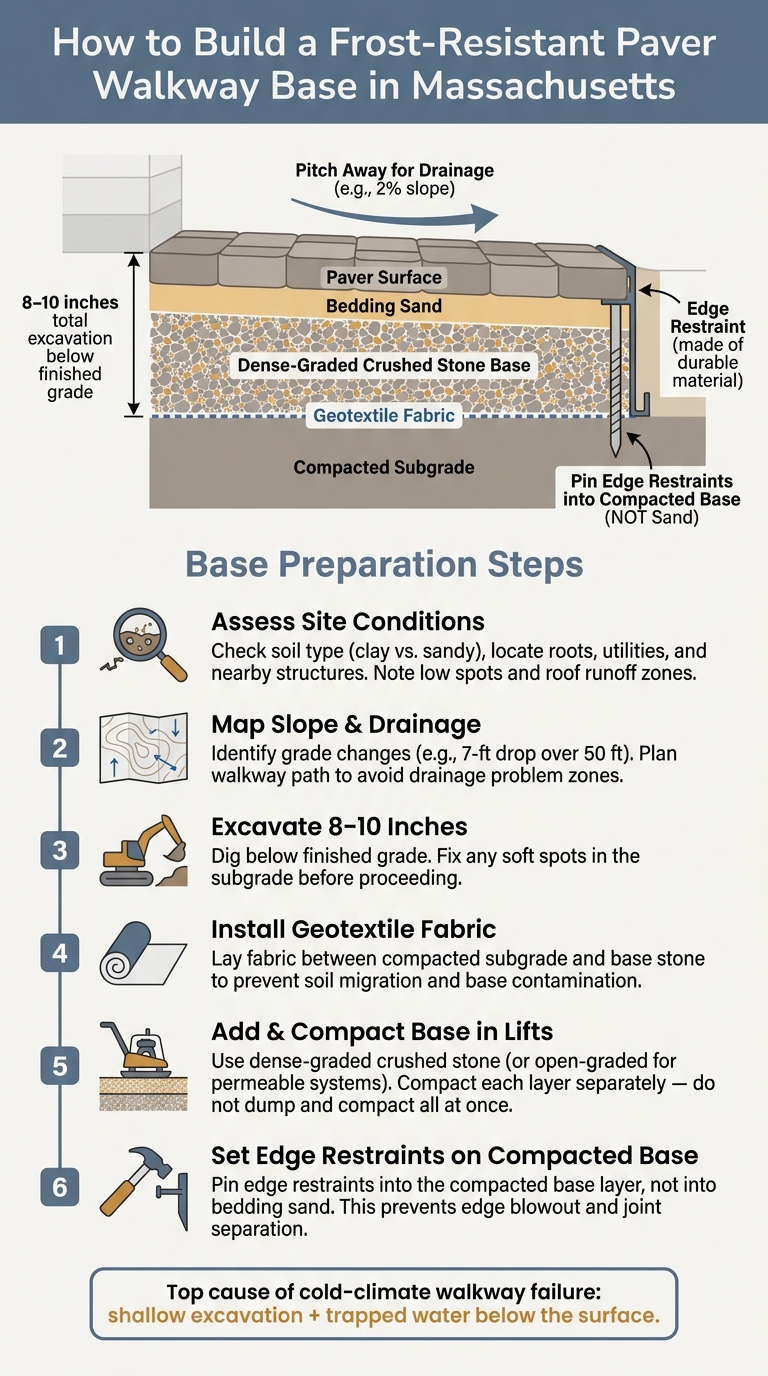
Paver Walkway Installation: Step-by-Step Base Prep for Massachusetts Winters
Once you’ve picked the paver, the next call is the one that decides how long the walkway lasts: the base.
The surface material shapes the look. The base work decides whether that walkway can handle Massachusetts winters. So even if you choose the right paver, it won’t matter much if the base underneath isn’t built for that system.
Most residential paver walkways in Massachusetts need 8 to 10 inches of excavation below finished grade.
That depth isn’t just a rule of thumb. It gives the base enough room to handle freeze-thaw cycles without pushing the surface out of shape.
Before any base material goes in, soft spots need to be fixed. If the subgrade is loose or unstable, the walkway can settle unevenly over time. After compacting the subgrade, install geotextile fabric between the soil and the gravel base. That layer keeps fine soil particles from working their way up into the base and weakening it from below.
Base installation also needs to happen in lifts, not in one big dump. Compact each layer as you go. That step gives you a denser, more stable base than trying to compact the full depth all at once.
The stone itself matters too:
Use the wrong aggregate, and the whole system starts fighting itself.
After the base is in place, the next job is making sure water leaves the surface instead of sitting on it.
A walkway should move water away before it gets into the joints or base. That means pitching the surface away from the house at a steady grade so water runs off instead of pooling.
On Merrimack Valley lots with bigger grade changes, that can affect more than slope alone. The walkway alignment, width, and transition points may all need to shift so runoff keeps moving in the right direction. For example, a 7-foot elevation drop over 50 feet takes careful planning between the walkway and any nearby steps or structures.
Transitions deserve extra attention early in the layout process. The trouble spots usually show up where the walkway meets:
Those are the places where runoff tends to collect first, and where weak drainage planning becomes hard to ignore.
Drainage matters at the perimeter too, because that’s often where movement starts. Without edge restraint, pavers can shift outward under foot traffic and frost pressure. Once that starts, the joints across the field begin to open up.
Edge restraint should be set on the compacted base, not on bedding sand. If it sits on sand, it can move - and when the restraint moves, the edge pavers usually move with it. Granite cobble edging is one option used in Massachusetts that gives the walkway structural support while also cleaning up the finished edge along walkways and aprons.
The table below shows the prep choices that help a walkway hold up against frost heave, joint separation, and surface icing.
| Feature | Adequate Preparation | Inadequate Preparation |
|---|---|---|
| Base Depth | 8–10" below finished grade | Shallow base; leads to rutting and uneven surfaces |
| Aggregate Type | Dense-graded (standard) or open-graded (permeable) | Unwashed or inconsistent stone; poor drainage |
| Geotextile Separation | Installed between subgrade and base | Omitted; results in base contamination and sinking |
| Edge Restraint Placement | Pinned into compacted base | Set on loose bedding sand; causes edge blowouts |
| Result | Stable field, tight joints, proper runoff | Pattern spread, joint separation, surface icing |
A paver walkway in Massachusetts lives or dies by what's underneath it. Base depth, drainage, and edge restraint placement decide whether the walkway stays put through freeze-thaw cycles or starts to shift, crack, and pull apart.
Poor base prep is the most common reason cold-climate walkways fail. A shallow base or one that traps water leads to frost heave and joint separation. That's where most projects go wrong.
Material choice should follow site conditions, not lead them. If your lot has drainage limits, permeable pavers may make more sense than a style-first pick. A steep grade means the layout needs to answer that slope before a single paver goes in. Oliver Enterprises applies that order on every North Andover walkway project — site conditions first, then material and layout decisions that match what the ground is actually doing.
Good results start with planning the base, drainage, and layout before installation begins. For help matching material, base, and drainage choices to your site, start with a hardscaping consultation.
Check your yard during or right after heavy rain. Look for signs that water isn’t draining well, such as:
In places like North Andover, dense glacial till can hold water in the ground. That can leave some spots soaked and more likely to frost heave. Photos taken in different weather conditions can help professionals figure out whether added drainage is needed.
Permeable pavers make the most sense when stormwater management matters. Instead of letting water sit on the surface, they allow it to move through the joints and into the sub-base below.
They work especially well on properties with poor drainage or in places where cutting runoff is a top goal. In North Andover, that can help with dense subsoil by improving infiltration and reducing water that gets trapped near the hardscape.
Common warning signs include uneven or shifting pavers, cracks, and joint separation. In Massachusetts, these issues often show up after the first spring thaw, when trapped water freezes, thaws, and pushes the pavers out of place through frost heaving.
You should also watch for persistent puddling or soggy spots near the walkway. Poor drainage is a clear red flag because it can weaken the base and make the problem worse.