What to expect from a poured concrete patio in North Andover: costs, frost risks, base specs, drainage, maintenance; when pavers are better.
Short answer: A concrete patio can work in North Andover, but only on the right site and only with solid prep. If your yard has poor drainage, clay-heavy soil, or slope, a rigid slab may crack sooner than you expect.
Here’s the plain-English version:
If I were sizing it up fast, I’d say this: concrete is best for flat, simple, lower-traffic spaces with good drainage. If you’re dealing with slope, poor drainage, or a main backyard hangout area, pavers often make more sense because they handle ground movement better and are easier to fix piece by piece.
A few things matter more than the finish itself:
That’s the big takeaway: in North Andover, the site decides whether concrete is a smart pick.
| Factor | Concrete Patio |
|---|---|
| Upfront cost | Lower in many cases |
| Best site | Flat yard with good drainage |
| Main risk | Cracking from freeze-thaw and water below slab |
| Repairs | Often visible |
| Winter wear | Salt and moisture can wear the surface |
| Best use case | Side yards, simple layouts, lower-traffic spaces |
If you want the direct answer before you read the rest: don’t choose concrete based on looks alone. Choose it only after the yard, drainage, and soil have been checked.
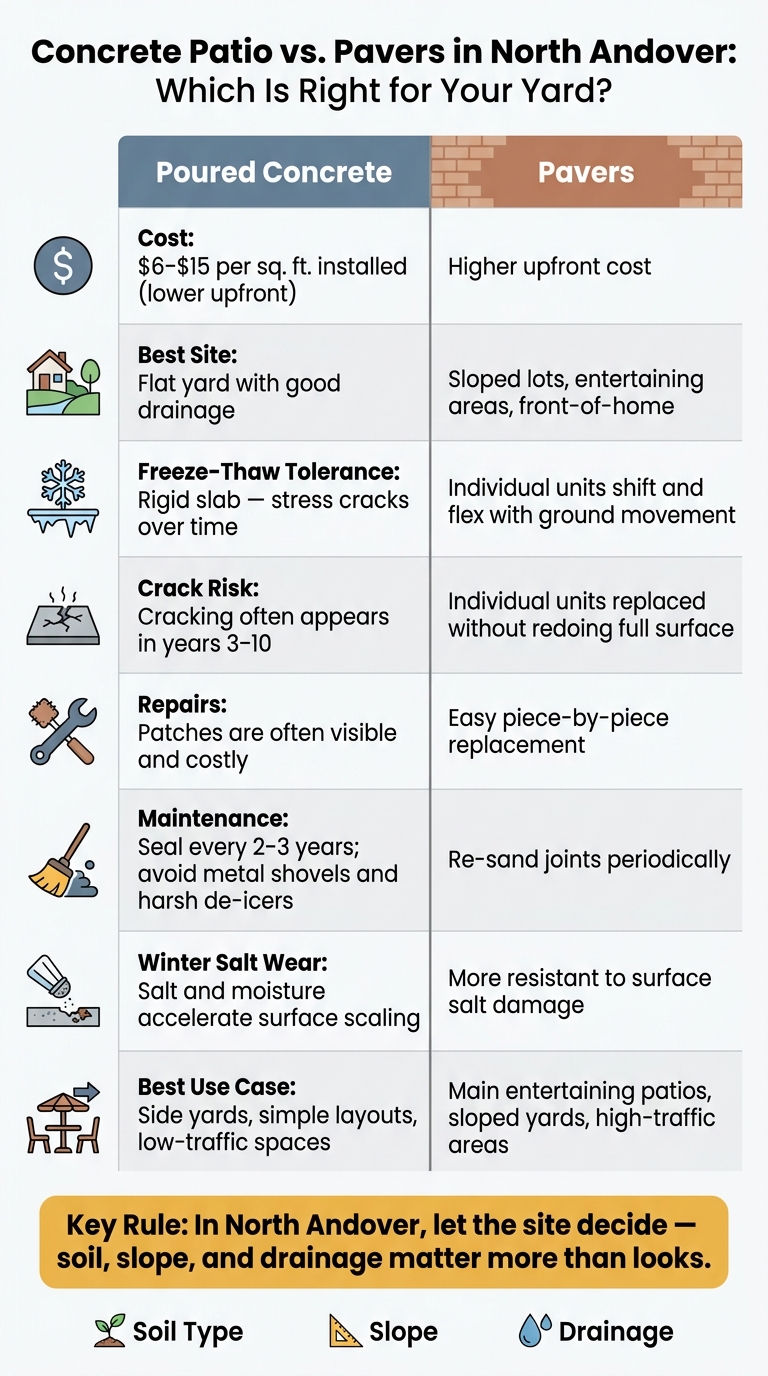
Concrete Patio vs. Pavers: Which Is Right for Your North Andover Yard?
Not every yard is a good match for poured concrete. A patio contractor in North Andover should check the lot, slope, and drainage before any design work begins.
Concrete usually makes the most sense on flat lots with simple layouts. It has the lowest upfront cost, and it fits homeowners who want a clean, modern look.
It also works well in side yards and utility spaces. In those areas, concrete’s weak points tend to matter less.
Sloped lots, entertaining areas, and front-of-home spaces are often a poor match for concrete. In North Andover, freeze-thaw movement can crack rigid slabs, and those repairs are often easy to spot and expensive to fix.
Pavers handle that movement better. Individual units can shift with freeze-thaw cycles, and damaged pavers can be replaced without redoing the whole surface - neither is true for poured concrete.
Concrete comes out ahead on upfront price and a smooth, seamless look. Pavers come out ahead on movement tolerance and ease of repair.
For a deeper comparison, see our Paver Patio vs. Concrete guide.
If concrete still looks like the right fit, the next step is to look at whether the slab, base, and joints are built for North Andover conditions.
In North Andover, a concrete patio stands or fails based on how it's built. Concrete only stays the low-cost choice when the slab meets local standards. If concrete still makes sense for the property, the install details will decide how long it holds up. A patio contractor in North Andover can verify these requirements before the job starts.
Here are the minimum specs a North Andover patio should include:
| Requirement | Specification | Why It Matters |
|---|---|---|
| Slab Thickness | 4" minimum, 6" preferred | Structural integrity under freeze-thaw stress |
| Gravel Base | 4–6 inches, compacted | Drainage and stable foundation in clay soil |
| Frost Depth | 48 inches (per MA 780 CMR) | Prevents frost heave from shifting the slab |
| Control Joints | Strategically placed | Directs cracking, prevents random fractures |
| Sealing | Every 2–3 years | Blocks moisture and protects against salt damage |
Four inches is the minimum. Six inches usually holds up better in freeze-thaw weather. In North Andover, clay soil doesn't drain well, so a thin base or a skipped gravel base is one of the fastest ways to end up with a cracked patio.
That freeze-thaw cycle is the whole issue here. Joints, base depth, and drainage aren't nice extras. They're part of the job. Control joints are placed to guide cracking into clean lines instead of letting the slab crack wherever it wants. Without them, shrinkage and temperature shifts will make their own path, and it usually looks rough.
Massachusetts Building Code (MA 780 CMR) sets the local frost depth at 48 inches. That's the frost line the slab has to account for. When water in the soil freezes, it expands. That upward pressure can move whatever sits above it.
Good excavation and drainage help cut down frost heave. A patio that's rushed, with shallow prep or compacted soil used in place of gravel, can heave and crack within a few winters. That's not a concrete issue. It's an install issue.
Sealer is part of the system, not just a finishing touch. It helps block moisture and salt damage, so it should be treated as part of the install, not an add-on. This matters even more near driveways or walkways where de-icing products are common.
A few habits help here:
Even then, sealer can't fully stop scaling. In North Andover, the weather has a way of exposing every shortcut.
Even a well-installed slab still has to deal with North Andover winters. Freeze-thaw cycles put concrete under stress because water inside the slab expands as it freezes. Once that water gets into tiny pores or hairline cracks, it pushes outward from the inside and starts wearing the surface down.
De-icing salts make scaling worse by pulling in moisture and adding more winter stress to the slab.
Visible cracking and heaving often show up between years 3 and 7, especially if the base was poorly prepared. In many cases, that early damage goes back to a few common problems:
Water under a slab can shorten its life fast. In North Andover, poor drainage traps water below the concrete, creates ice in winter, and speeds up cracking.
If a patio doesn't slope away from the house, runoff can pool, freeze, and put more stress on the slab. If standing water or runoff is already a pattern on your property, drainage work should be part of the project.
Those site conditions also help shape whether poured concrete makes sense in the first place.
With poured concrete, the big issue is simple: can the site handle a rigid slab through North Andover's freeze-thaw cycles without trapping water? If the answer is no, concrete can wear out a lot sooner than expected. That’s why the site review matters so much. It tells you whether concrete is a good fit or a short-term fix.
A qualified patio contractor in North Andover should inspect the site before suggesting any material. Soil type matters more than most people think. Clay-heavy soil holds water, which can mean deeper base work or extra drainage. And the patio’s job matters too. A small patio for two chairs isn’t dealing with the same stress as one built for a grill, fire pit, and regular get-togethers.
The two things that most often change the recommendation are load and intended use and drainage conditions. Once those are clear, picking the right material gets a lot easier.
Poured concrete can be a smart pick when the budget is tight, the yard is flat, drainage is already in good shape, and you want a clean, modern look. It also works well in low-traffic side yards where surface wear over time isn’t a major concern.
It usually struggles on sloped lots, clay-heavy soil, or patios built for frequent entertaining. In those cases, ground movement and drainage pressure can shorten the life of a rigid slab.
If you're still comparing concrete and pavers, read our Paver Patio vs. Concrete guide before moving ahead with a patio installation in North Andover. Oliver Enterprises has been building patios across North Andover since 1988. Contact us to talk through your project before you commit to a material.
In North Andover, a poured concrete patio usually lasts 10 to 25 years. The big factor is how well it was installed.
If the base is rushed, skipped, or done poorly, cracks can start showing up in 2 to 3 years as freeze-thaw cycles take their toll. A proper install, with the right base depth and drainage, gives the patio a much better shot at lasting for decades.
For a concrete patio in North Andover, a site inspection should look at soil conditions, slope, and drainage first. That gives the contractor a clear read on how the patio should be built and what the site can handle.
A qualified contractor should also measure the area, flag any existing drainage problems, and figure out the excavation depth needed for a 4- to 6-inch compacted gravel base.
The inspection should also confirm whether a permit or Conservation Commission review is required. Just as important, it should make sure the finished patio slopes away from the home so water doesn’t collect and lead to pooling, ice buildup, or structural failure.
Pavers are often the better pick in North Andover because they handle seasonal ground movement better than poured concrete. Concrete forms one rigid slab, so freeze-thaw cycles can lead to cracking. De-icing salts can also cause surface spalling over time.
Pavers, on the other hand, can shift a bit without cracking. And if one piece gets damaged, you can replace that unit without tearing out the whole surface.
They’re a smart option for high-traffic entertaining areas and sloped lots.