Typical brick repointing costs in Massachusetts ($300–$2,500+), plus timing, weather limits, inspection steps, and what to expect during the job.
If your mortar is cracking or falling out, brick repointing usually costs about $300 to $2,500+ in Massachusetts, and timing matters just as much as price.
If the brick or stone is still in good shape, repointing can stop water from getting into the joints and slowing more freeze-thaw damage. In most cases, the final price depends on how much joint work you need, how deep the damage goes, how hard the area is to reach, and whether the mortar needs to match older masonry.
Before booking the job, you should know three things:
You should also expect:
If bricks or stones are loose or broken, repointing may not be enough. In that case, you may need a larger repair instead of joint-only work.
The guide below breaks down cost, timing, weather limits, warning signs, and what the job looks like from start to finish so you can tell what to expect before you ask for an estimate.
Repointing follows a pretty clear path: inspect the masonry, remove failed mortar, place new mortar, then finish and clean up. In Massachusetts, that order matters. Freeze-thaw damage often goes deeper than what you can see on the surface, so a careful approach helps the crew deal with more than just the obvious cracks.
The process starts with an on-site inspection to set the scope and schedule. At this stage, the crew looks at the condition of the joints, the work area, and anything that could affect access or timing. They also protect nearby surfaces and contain dust and debris so the job site stays under control.
Once the scope is set, the crew can move into removal and prep.
Next, the crew removes deteriorated mortar and cleans the joints before adding new material. This step has to be done with care, because the new mortar needs a clean, sound joint to bond the right way.
After that, the crew packs in fresh mortar to match the surrounding masonry. The goal isn't just to fill gaps. It's to restore the joints so they fit the wall and perform the way they should.
The new mortar should match the brick or stone in color, texture, and joint profile. If the match is off, the repair can stand out in all the wrong ways. On older masonry, that visual match is a big part of doing the job well.
The job ends with a final inspection and cleanup. These steps also affect cost, especially on larger areas, deeper joints, and hard-to-reach masonry.
Brick Repointing Costs in Massachusetts: Scenarios & Price Drivers
Once the masonry is inspected, the price usually comes down to two simple things: how much mortar needs to be replaced and how hard the area is to reach. In Massachusetts, repointing costs are mostly shaped by joint length, joint depth, and access.
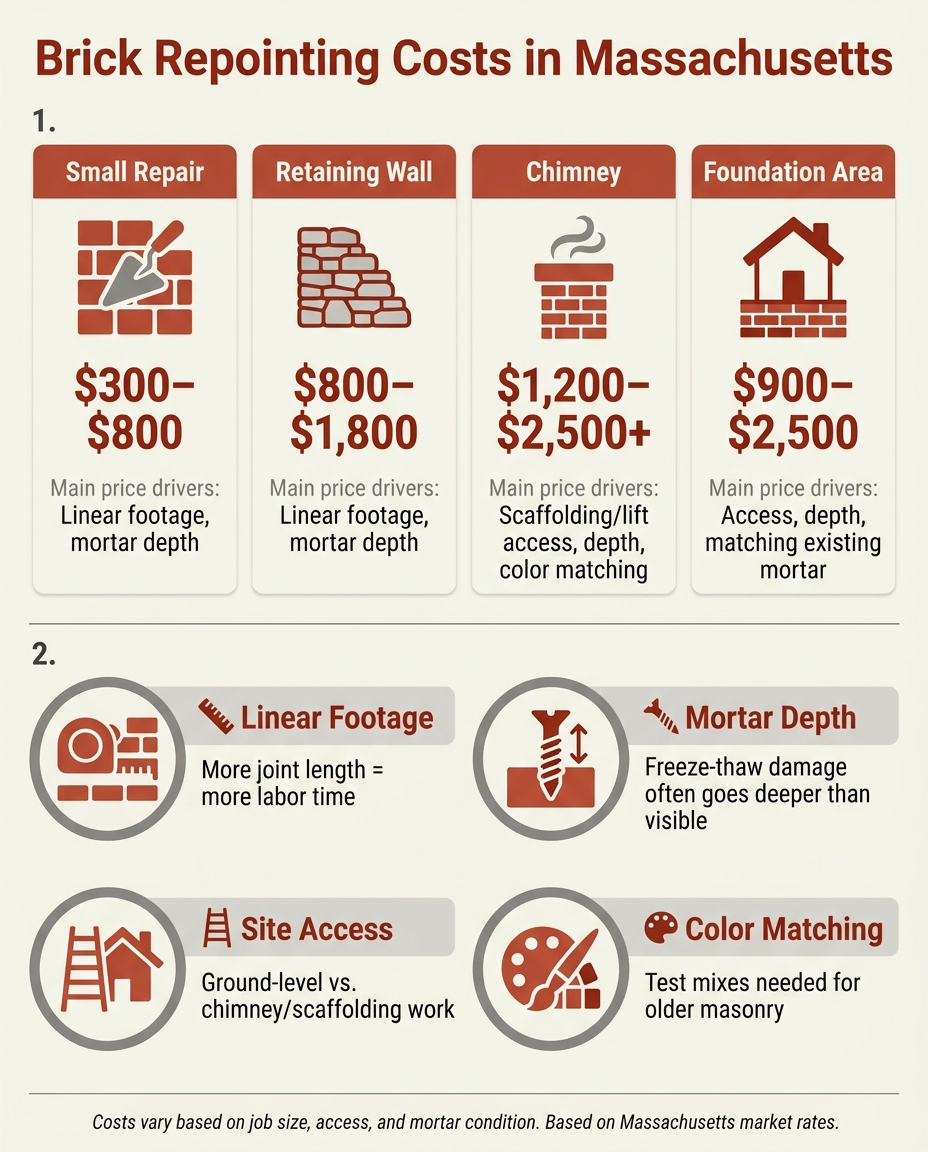
Small repointing jobs - like a section of steps, a short stretch of foundation wall, or a handful of damaged joints - usually fall between $300 and $800. Mid-size work, such as a retaining wall or one full chimney face, often lands in the $800 to $2,500 range.
Bigger or more involved jobs, including full chimney rebuilds or large foundation repointing projects, can hit $3,000 or more depending on access and how deep the mortar damage goes.
A good estimate should break out:
Linear footage is the clearest pricing factor. More joints to repoint means more labor time.
Mortar depth also plays a big part. Freeze-thaw damage in Massachusetts often goes deeper than the surface suggests, so deeper joints take longer to remove and refill.
Hard access raises costs. Ground-level brickwork is usually easier to handle than a chimney or upper wall that needs scaffolding or lift equipment.
Mortar color matching can add time near the end of the job. With older masonry, crews may need a few test mixes to get close to the existing color and texture.
| Scenario | Typical Range | Main Price Drivers |
|---|---|---|
| Small repair | $300–$800 | Linear footage, mortar depth |
| Retaining wall | $800–$1,800 | Linear footage, mortar depth |
| Chimney | $1,200–$2,500+ | Scaffolding or lift access, depth, color matching |
| Foundation area | $900–$2,500 | Access, depth, matching existing mortar |
When you review quotes, don't just look at the visible surface area. Check for notes about depth, access, and finish work too. Weather can affect scheduling as well, since mortar needs a warm, dry stretch to cure the right way.
Planning a repointing job in Massachusetts takes more than picking a free weekend. Mortar has a hard temperature limit: it needs sustained temperatures above 40°F during application and curing. If mortar freezes before it fully cures, the bond strength drops.
Fresh mortar needs sustained temperatures above 40°F during both application and curing. If it freezes before it sets, the bond weakens.
In Massachusetts, late spring through early fall is usually the safest window for masonry repointing. Those months are more likely to bring the steady warmth mortar needs to cure the right way.
Still, the calendar only gets you so far. The forecast matters more than the season on paper. A mild stretch in April may work better than a cold snap in May. That’s why it makes sense to book an assessment in early spring and aim for the best weather window.
Even during the best part of the year, weather can shift the schedule. Rain, strong winds, and overnight temperature drops are the usual trouble spots.
Rain can disrupt fresh mortar before it sets. Strong winds can dry mortar too fast, which can weaken the cure. And mild daytime weather doesn’t always mean the job is safe to start. If the temperature falls below 40°F overnight, curing can be affected unless the work area is protected.
Freshly repointed sections often need tarps or protective sheeting during curing to help guard against sudden weather changes.
| Condition | Suitability | What It Means for the Project |
|---|---|---|
| Sustained 40°F+ and dry | Ideal | Standard workflow; minimal protection needed |
| Near 40°F or light rain | Borderline | Site protection required; curing may be slower |
| Below 40°F or heavy rain | Unsuitable | High risk of bond failure; project must be delayed |
| High winds | Unsuitable | Mortar dries too fast; scaffolding safety concerns |
Once the weather window is set, the crew can move into site setup, removal, and repointing.
Once the old mortar is cut out and new mortar goes in, most homeowners notice four things right away: limited access, noise, dust, and cleanup.
When the job starts, the crew confirms site access, repoints the joints, and cleans up at the end of the day. That usually means some areas are blocked off for safety, tools make a fair amount of noise, and dust is part of the process. It’s not unusual for the work zone to feel a bit busy while the job is underway.
To keep things simple, you’ll usually have one point of contact for updates and questions during the project.
After the crew wraps up, the new mortar starts curing and the repair begins to blend with the rest of the wall. At first, fresh mortar often looks different in color or texture. That’s normal. As it cures, it hardens and blends in more with the existing masonry.
The crew should finish with a final walkthrough and leave you with repaired joint lines that match the surrounding masonry and are ready for normal exposure once curing is underway. Even after the crew leaves, curing continues.
On sound masonry, repointing is meant to last for years. In Massachusetts, though, it’s still a form of maintenance. Freeze-thaw weather takes a toll, so repointing will need to be done again at some point.
If you’re seeing crumbling joints or water staining, the next move is a masonry assessment.
In Massachusetts, freeze-thaw cycles shorten mortar life, which makes repointing recurring maintenance. Project cost usually comes down to four factors:
Most repointing jobs are scheduled during the warmer months, when sustained temperatures above 40°F help mortar cure the right way.
Request a masonry assessment in North Andover and the surrounding Greater Boston communities, or find us on Google Maps to connect locally.
Repointing is often the right fix when the brick or stone itself is still in good shape, but the mortar joints are cracked, crumbling, or missing. It helps restore the masonry’s strength and improves its resistance to water.
If you notice bulging, bowing, or major shifting, the issue likely goes beyond the mortar joints. At that point, it may be time for a professional assessment to see whether more repair or full replacement is needed.
When it’s done right, brick repointing can last for decades. But weather has a lot to say about how long it holds up.
In Massachusetts, homes often go through 30 to 40 freeze-thaw cycles each year. That constant shift between freezing and thawing can wear mortar down faster than many people expect. So repointing is best treated as routine upkeep, not a one-and-done repair.
It also helps to match the new mortar closely in both color and composition. That supports the brickwork and helps it last longer.
No. Mortar needs steady temperatures above 40°F to cure the right way, so repointing in Massachusetts should wait for the warmer months.
Winter is a good time to check for masonry damage and line up a contractor before the spring rush.