Match the right contractor to the job, verify registration/insurance, confirm cold‑climate experience, and get footing, drainage, and warranty details in w
A low bid can cost you more if the masonry fails after one winter.
If you’re hiring a masonry contractor, focus on five things first: the type of work, license and insurance, cold-weather job history, footing and drainage plans, and the written scope and warranty. In places like North Andover and the Merrimack Valley, freeze-thaw damage can shorten the life of masonry fast when water control and base prep are weak.
Here’s the short answer: hire the contractor who can explain the job in plain language, show older local projects, provide current insurance and registration, and put excavation, drainage, materials, and warranty terms in writing. If any of that is missing, the risk goes up.
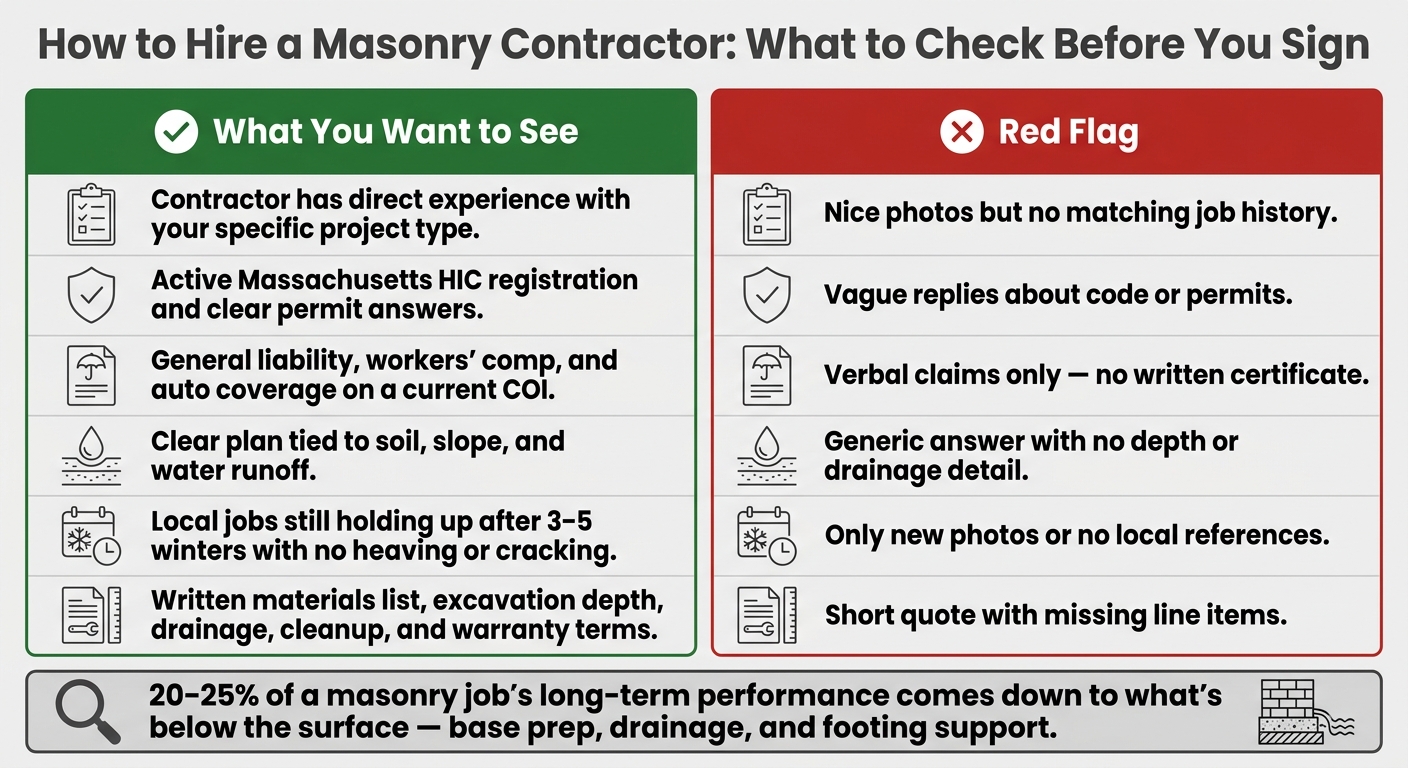
How to Hire a Masonry Contractor: Red Flags vs. Green Lights
| What to Check | What You Want to See | Red Flag |
|---|---|---|
| Project fit | Contractor has direct experience with your project type | Nice photos, but no matching job history |
| Registration and permits | Active HIC registration and clear permit answers | Vague replies about code or permits |
| Insurance | General liability, workers’ comp, and auto coverage on a current COI | Verbal claims only |
| Footing and drainage | Clear plan tied to soil, slope, and water runoff | Generic answer with no depth or drainage detail |
| Past work | Local jobs still holding up after several winters | Only new photos or no local references |
| Scope and warranty | Written materials list, excavation, drainage, cleanup, and warranty terms | Short quote with missing details |
About 20% to 25% of a masonry job’s long-term performance often comes down to what happens below the surface - base prep, drainage, and footing support - not just the finish you can see. That’s why the right hire is usually the one with the clearest plan, not the cheapest number.
The rest of this guide breaks down what to check before you sign.
Start by defining the project. That sounds basic, but it changes everything. Masonry covers both structural and decorative work, and the right contractor depends on what you're building. Once you know the project type, you can match the contractor to the job instead of guessing.
These jobs may sit under the same “masonry” label, but they don’t call for the same skills.
Structural walls and steps need footing and drainage know-how. Patios, walkways, and veneer depend more on solid base prep and clean finish work.
Here’s where people get tripped up: a contractor who does nice decorative work can miss footing and drainage needs. On the flip side, a contractor who mainly handles structural masonry may overbuild simple flatwork. The goal is to match the contractor’s main experience to the actual job. If you don’t, you risk settling, cracking, or drainage failure.
Once the project is clear, licensing and insurance are the next filter.
Structural masonry does more than look good. It supports weight or holds back soil. Think retaining walls resisting soil pressure, steps tied into a grade change, or masonry connected to a foundation.
Those projects need proper footing depth and drainage built into the plan from day one. Decorative masonry - like granite cobble edging, a fire pit, or a decorative veneer accent - usually sits on the ground for looks or light use. There’s a bit more room for small mistakes there. Structural work doesn’t give you that cushion.
If the footing is wrong on a retaining wall, the wall can move. If drainage is skipped on load-bearing stairs, frost heave can cause movement, joint failure, and spalling.
Treat the job as structural if it does any of the following:
In the Merrimack Valley, freeze-thaw cycles put masonry under steady stress. Water gets in, temperatures swing, and weak installation details start to show. Without enough base depth, proper drainage, and the right material choices, you can end up with frost heave, joint failure, spalling, and shifting over time.
That’s why local experience matters so much. It’s not just a nice extra. In this area, base depth, drainage, and material selection are the baseline for a durable install. You should see that experience reflected in the contractor’s licensing, scope, and warranty.
Licensing and insurance are the next filter. And the paperwork can change based on the job. A patio is one thing. Steps or a structural wall are another.
In Massachusetts, residential masonry contractors should have an active Home Improvement Contractor (HIC) registration with the Massachusetts Office of Consumer Affairs and Business Regulation (OCABR). Check that the registration is active before you sign.
It also helps to ask when a permit is needed. Structural walls, masonry steps, and excavation-heavy jobs often need a local permit. If the work involves excavation or heavy equipment, a hoisting license may be required too.
A good contractor should be able to explain this stuff in plain English. If they get vague or brush past permit questions, that’s a red flag.
Ask for a current Certificate of Insurance (COI) sent straight from the contractor’s insurance agent. It should show:
That direct send matters. It gives you a cleaner way to check that the policy is current and tied to the business doing the work.
Not all masonry work is treated the same by an insurance policy. Some policies exclude structural failures or set limits for walls above a certain height. So ask whether the policy covers structural masonry the same way it covers decorative work.
Then ask for those policy details in writing and compare them with the scope of work. A backyard sitting wall and a load-bearing wall may sound similar on paper, but the risk is not the same.
Once licensing and coverage check out, look at projects that have already survived several winters.
Once licensing and coverage check out, the next step is simple: see whether the contractor knows how masonry holds up in cold weather.
A good masonry contractor should be able to talk through site conditions without you having to drag the answers out of them. Ask how they handle grading, drainage, and water runoff on projects like yours.
Be direct about de-icing exposure too. If the contractor has spent years working in the Merrimack Valley, they should be able to explain which materials tend to last through Massachusetts winters and which ones tend to fail.
Ask to see completed projects with:
That same know-how should show up when they explain footings, not just when they show you nice-looking finished work.
For structural work, you should get a clear explanation of the footing plan. For decorative work, the contractor should still explain the base and drainage setup. Ask how they decide when a footing is needed and how soil and drainage affect the depth.
The answer should fit the project type, the soil, and the drainage conditions. If it sounds vague or generic, that's a red flag.
A new install can look great in photos. That doesn’t tell you much. What you want to see is work that’s 3 to 5 years old and still holding up well.
Ask for references or local job sites you can visit. Then check for visible signs of failure or success: no heaving, cracking, washout, leaning, or base separation.
If a contractor can’t show you older local work, make a note of that.
Once you've checked qualifications, the contract becomes the last big test. Experience tells you whether a contractor can do the job. The written agreement tells you whether the job will be done right. A price alone isn't enough. The scope should show that the contractor has planned the build from start to finish.
A good scope of work should spell out the full job. That includes demolition if old material needs to be removed, excavation depth, base thickness, compaction method, footing details for structural work, reinforcement, drainage provisions, and the exact type, size, and finish of every material being installed.
On sloped sites, the contract should also explain how the crew will fine grade the area so the finished work ties into the existing grades. Cleanup, restoration, and a final walkthrough should be included too.
When the scope is written well, comparing bids gets much easier. You can look at each line and see what's there, what's missing, and where one contractor may be cutting corners.
A blanket promise like "we stand behind our work" sounds nice, but it doesn't say much. The contract should break out workmanship, materials, and structural coverage, with a clear length of time for each.
Workmanship warranties usually last 1 to 5 years and cover how the work was done, such as mortar joints, stone placement, and surface finish. Structural coverage should address the stability of the installation itself, including footings and retaining walls. Material warranties are often handled by the manufacturer, but the contractor should still be able to explain how a claim works if something goes wrong.
Exclusions matter too. In the Merrimack Valley, ask whether heaving, separation, or winter movement is excluded.
If two bids seem close, the warranty language often tells the real story.
A lower bid isn't always the better deal. Sometimes it just means key parts of the job were left out. A side-by-side table makes that much easier to spot.
| Comparison Feature | High-Quality Bid | Low-Cost Bid |
|---|---|---|
| Excavation and Base Depth | Specified excavation depth and compacted base thickness | Vague or missing depth and base details |
| Drainage Details | Drainage line item with method and materials listed | No mention of drainage provisions |
| Materials Specified | Exact types, dimensions, and brands listed | Generic terms (e.g., "stone", "bricks") |
| Cleanup and Restoration | Site cleanup, grading restoration, and final walkthrough included | Not mentioned or left to verbal agreement |
| Warranty Exclusions | Written terms with clear exclusions listed | Verbal only or blanket coverage with no exclusions defined |
| Payment Schedule | Milestones tied to project phases | Large upfront deposit required |
| Total Price (USD) | Reflects labor, quality materials, and prep work | Significantly lower; often hides missing prep |
Use the table to find missing scope, not just the lowest price. When you compare scope, warranty, and cost side by side, the best bid should feel consistent from the first line to the last.
After you compare bids, the last check is simple: can the contractor explain the job clearly and put every part of it in writing?
That matters more than a lot of homeowners think. A patio or walkway calls for a different skill set than a retaining wall or a set of masonry stairs. The right match matters. You should also verify that the contractor’s registration is current and ask for a Certificate of Insurance that shows general liability and workers' compensation.
Then get specific. Ask them to walk you through footing depth, drainage, and winter movement in plain English. No jargon. No dodging. They should also be able to point to local projects that have made it through several winters and still look sound. Before you sign anything, make sure the written scope and warranty cover excavation, materials, drainage, and finish details.
Oliver Enterprises has fielded these questions on North Andover jobs for over 35 years, and the contractors who answer them without hesitation tend to be the ones whose work holds up after the first hard freeze.
In freeze-thaw conditions, small details can make or break the job. If a contractor can answer these points clearly and back them up in writing, that’s usually a strong sign you’re talking to the right crew.
For wall-specific projects, the stone wall contractor hiring guide goes deeper on that type of work.
A masonry project is structural when it does more than look good. If it carries weight, holds back soil, or needs engineering to deal with North Andover’s climate, it falls into that category. Common examples include retaining walls, especially those over 4 feet tall, along with permanent steps or columns that need 48-inch frost-depth footings.
If your project deals with soil pressure, drainage, or grade changes, it will usually need professional design, proper footings, and code compliance. For wall-specific guidance, see our stone wall contractor article.
Ask how the contractor deals with North Andover’s freeze-thaw cycles and poorly draining soil. You want to hear how they build for those site conditions, not just how they pour concrete.
Make sure they follow the 48-inch frost depth required by state code. That matters because a shallow footing can lead to frost heaving, shifting, and cracks once winter sets in.
You should also ask for their drainage plan. That includes:
If the wall is over 4 feet tall, confirm that they can take care of any permits and engineering approvals that may be required.
A masonry quote should spell out the work in writing. That means the project design, site prep, materials, and any footing needs should all be listed clearly. Why does that matter? Because it sets expectations and makes it much easier to hold everyone accountable, whether you're hiring for a patio, front steps, or a structural wall.
It should also cover warranty terms and explain liability coverage for structural and decorative work. If your project is a stone wall, see our separate stone wall contractor hiring guide.