New England outdoor kitchen guide: choose freeze‑thaw safe counters, weatherproof cabinets, frost‑deep footings, sealed joints.
If your outdoor kitchen can't handle water, frost, and heat swings, it can crack, rust, or shift after just one New England winter.
For Massachusetts homes, the best setup usually comes down to five calls: freeze-thaw-safe countertops, weather-ready cabinets, a masonry base below the 48-inch frost line, durable joints and sealants, and a fuel type that fits local code. The climate can swing from -10°F in winter to 95°F in summer, so weak seams, porous stone, and poor drainage are often where trouble starts.
Before building, keep your focus on:
A fast side-by-side check makes the choices easier.
Quick Comparison
| Area | Best Picks | Avoid | Main Reason |
|---|---|---|---|
| Countertops | Granite, quartzite, porcelain, sintered stone | Indoor quartz, marble, travertine, limestone | Lower water uptake and better outdoor wear |
| Cabinets | HDPE, powder-coated aluminum, 304/316 stainless | Indoor-grade cabinets | Less swelling, rust, and weather damage |
| Base | CMU block with stone veneer | Wood framing | Wood can hold moisture and break down |
| Joints | Polymer-modified mortar, frost-rated joint sand | Weak or indoor-grade joint products | Joints often fail before slabs do |
| Fuel | Gas | Wood-burning in towns with tight rules | Gas is often easier to permit |
Your best path is simple: pick materials that stay dry, build below frost depth, and check code before the layout is final.
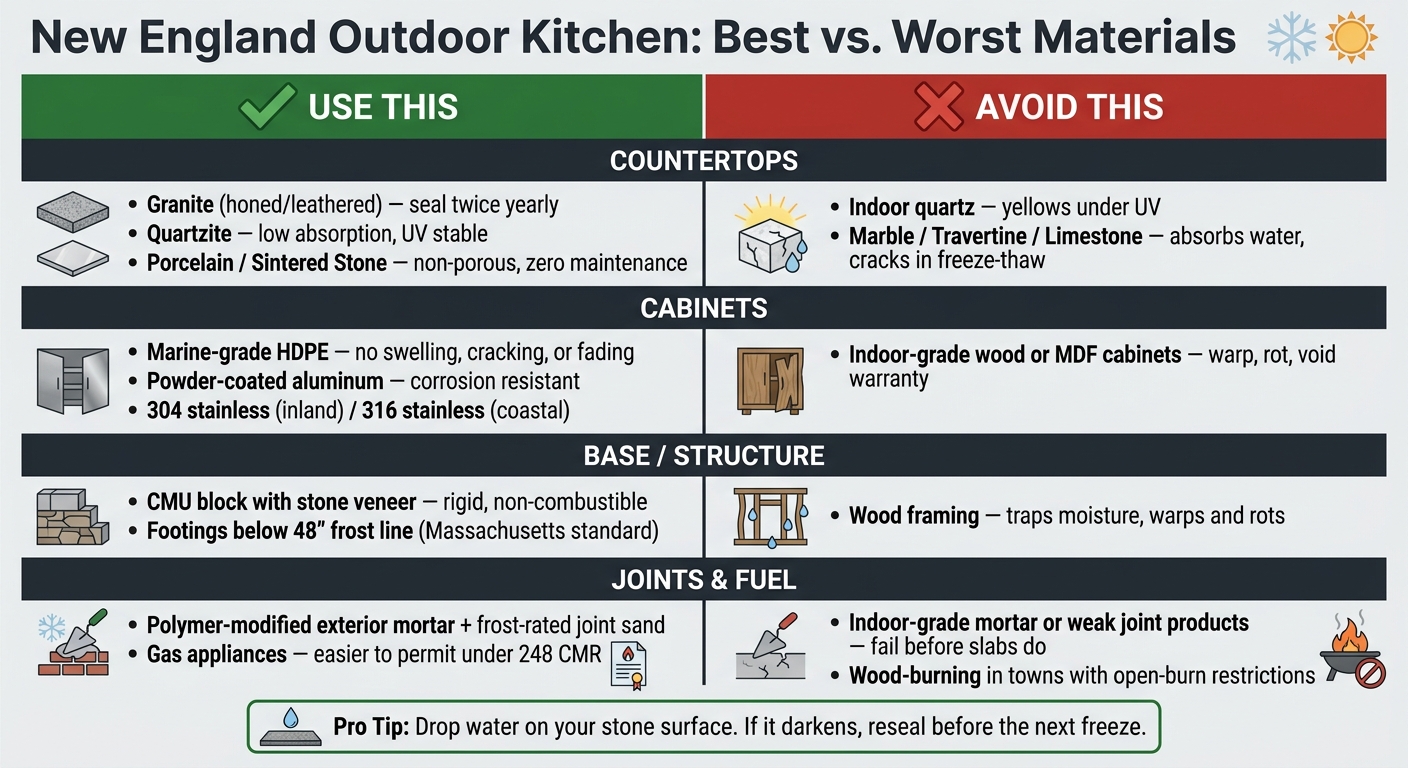
New England Outdoor Kitchen Materials: Best vs. Worst Picks
In a New England winter, water is the main troublemaker. Once it gets into seams, joints, or small gaps and then freezes, damage can start fast. That’s why drainage, tight joints, and good sealants matter more than almost anything else.
In most Massachusetts towns, permanent footings need to go below 48 inches. The site should also slope so water moves away from the structure instead of sitting against it. If water pools near the base, freeze-thaw cycles can wear things down over time.
Exposure plays a big role too. It affects how comfortable the space feels and how well the materials hold up. Orientation can help cut down on smoke blowback and make cooking less miserable by taking prevailing winds and afternoon sun into account. For materials, stick with marine-grade stainless steel or powder-coated aluminum. Mild steel and untreated zinc can rust fast outdoors.
Water lines need the same level of care. Shut them off and drain them before the first hard frost. If water gets trapped inside, it can freeze and burst the pipes.
Those winter pressures are exactly why countertop, cabinet, and masonry choices come next.
Freeze-thaw damage usually shows up first at joints, seams, and sealant lines.
For countertops, granite and quartzite are the safest natural-stone picks for New England. They have low absorption and hold up well through temperature swings. Go with honed, leathered, or brushed finishes. Skip polished slabs and resin-heavy options, since they tend to wear poorly outside.
Porcelain and sintered stone take it a step further. They’re non-porous and highly resistant to freeze-thaw damage.
For cabinetry, marine-grade HDPE is a smart pick because it resists water absorption, swelling, cracking, and chalking. Powder-coated aluminum and marine-grade stainless steel also work well for frames and hardware.
For the base, CMU block finished with natural stone veneer or masonry gives you a rigid, non-combustible structure. Avoid wood framing. It traps moisture, then warps and rots. That choice matters even more once you pick between gas and wood-burning equipment.
And here’s the part people often miss: joints tend to fail before slabs do. Use exterior-rated, polymer-modified mortar and frost-resistant joint sand so the assembly can move through the seasons without opening up.
| Material | Category | New England Performance | Notes |
|---|---|---|---|
| Granite (honed/leathered) | Countertop | Strong | Seal twice a year, especially before winter and after the last freeze |
| Quartzite | Countertop | Strong | Low absorption, durable natural-stone option |
| Porcelain / Sintered stone | Countertop | Excellent | Non-porous, highly resistant to freeze-thaw damage |
| Indoor quartz | Countertop | Poor | Can yellow and deteriorate under UV exposure |
| Marble / Travertine / Limestone | Countertop | Poor | Moisture absorption and freeze-thaw cracking risk |
| Marine-grade HDPE | Cabinetry | Excellent | Resists water absorption, swelling, cracking, and chalking |
| Powder-coated aluminum | Cabinetry | Strong | Good outdoor option for cabinet frames |
| Marine-grade stainless steel | Cabinetry | Strong | Useful in coastal settings |
| Wood-framed bases | Base | Poor | Traps moisture, warps, and rots |
| CMU block | Base | Excellent | Best paired with natural stone veneer or masonry |
| Exterior-rated, polymer-modified mortar | Joints | Strong | Handles freeze-thaw movement without cracking open |
Once the materials are set, the next call is fuel type and code compliance.
For Massachusetts outdoor kitchens, the right countertop usually comes down to porosity first. Then look at edge support. If a surface takes on water, freeze-thaw cycles can be rough on it. And if the slab is thin, weak support around the edges can turn into trouble fast.
Granite (honed or leathered finish)
Granite is a solid low-porosity stone for outdoor use. Go with a honed or leathered finish. High-polish surfaces don’t hold up as well outside. Seal it twice a year - once in the spring after the last freeze, and once in the fall before the first hard frost.
If you want less upkeep, it makes sense to move from sealed stone to non-porous slab surfaces.
Porcelain or sintered stone
Porcelain and sintered stone are non-porous and low-maintenance. These slabs are often thin, usually 12 mm to 20 mm, so they need strong support under larger overhangs.
Quartzite
Quartzite is a strong natural-stone pick with good UV resistance. Seal it twice a year with a penetrating exterior-grade sealer.
A simple check works well here: place a few drops of water on the stone. If the water beads, the seal is still doing its job. If the surface darkens, reseal before the next freeze.
Once the countertop is set, match it with cabinet materials that can stay dry through winter.
Once the countertop is in place, the cabinet base becomes the next trouble spot. Snowmelt and splashback tend to gather there, and that’s where cabinets usually start to break down: around doors, drawers, hinges, and the toe-kick. If water sits there long enough, damage follows. That means the cabinet base needs the same freeze-thaw resistance as the countertop.
Indoor-rated cabinets don’t last long outside. Heat, cold, moisture, and constant temperature swings wear down the materials fast and can void the warranty.
In New England, three cabinet materials tend to hold up well:
That said, even good cabinet material can fail if the base traps water. The setup around the cabinets matters just as much as the cabinet itself. Doors and drawers should be weatherstripped, and the base should allow for drainage and airflow so moisture doesn’t build up inside or underneath. That airflow also helps keep the nearby masonry and base drier.
Once you've picked the countertop and cabinet materials, the structure underneath does the heavy lifting. That's what keeps the island steady through winter. If the base shifts from frost or the joints start to move, cracks can show up fast.
Three masonry choices have the biggest effect on winter performance:
Once the base and joints are right, the next call is fuel type and code compliance.
With the base and joints locked in, the next call is the heat source and the space it needs around it. In practice, code drives this choice just as much as the look and feel of the build.
After the code review, the layout comes down to how you'll use the space through the seasons and how people will move through it.
Compare materials by how they hold up, not by how they look under showroom lights. In Massachusetts, the big things to check are freeze-thaw resistance, porosity, UV stability, corrosion risk, sealing, and how well joints hold over time. Fire safety near burners matters too. The simplest way to stay consistent is to run every material through the same checklist:
Start with the water test for a quick read, then compare materials by category. Natural stone needs regular sealing, and the table below shows the schedule.
Countertop materials:
| Material | Freeze-Thaw Resistance | UV Stability | Sealing Needs | Notes |
|---|---|---|---|---|
| Granite | High | High, especially in honed or leathered finishes | Twice yearly | Strong all-around choice |
| Quartzite | High | High, especially in honed or leathered finishes | Twice yearly | Marble look |
| Porcelain | Excellent | Excellent | None | Low-maintenance |
| Concrete | Moderate | High | Regular sealing | Best for custom shapes |
| Standard Quartz | Low | Poor - yellows | None | Do not use outdoors |
For cabinets and frames, corrosion is the issue that can sneak up on you. A material that works fine inland may struggle near salt air.
Cabinetry and frames:
| Material | Corrosion Risk | Service Life | Notes |
|---|---|---|---|
| 304 Stainless Steel | Moderate, high near the coast | 10–15 years | Inland standard |
| 316 Stainless Steel | Low | 25+ years | Coastal standard |
| Powder-Coated Aluminum | Low | 20+ years | Weather-resistant with color options |
| Marine-Grade Polymer | None | 20+ years | Resists rot, swelling, and fading |
Masonry and paving need the same kind of side-by-side check. The surface may look solid on day one, but joints, porosity, and footing depth decide how it ages.
Masonry and paving:
| Material | Joint Durability | Porosity | Expected Life |
|---|---|---|---|
| Natural Stone (Granite/Bluestone) | High | Low to moderate | Lifetime |
| Concrete Pavers | Moderate | Moderate | 20–30 years |
| Block with Stone Veneer | High, with deep footings | Low | 25+ years |
Any permanent island or veneer system still needs frost-line footings to avoid heave.
For outdoor surfaces, stick with honed, leathered, or brushed finishes. Skip polished exotic slabs. Sunlight can yellow or cloud resin-filled surfaces.
After the structure is narrowed down, the next filter is fuel type and code clearance.
In Massachusetts, your fuel pick shapes more than taste. It affects code, clearances, upkeep, and how the space works in winter. In that way, fuel choice carries the same kind of weight as countertops, cabinets, and masonry.
Gas appliances fall under 248 CMR, and any gas line extension has to be installed by a licensed plumber or gasfitter. Built-in grills often pull 60,000 to 90,000 BTUs, and older homes may need a meter upgrade to carry that load. That check should happen before the layout is locked in. If you skip it, you can end up redesigning the plan after the fact.
Wood-burning rules change from town to town, so it’s smart to check with the local fire or building department before picking a wood-fired oven or fireplace. Some towns set tighter setbacks and seasonal limits than they do for gas. When those local rules are strict, a gas-first layout is often the safer path.
Covered setups need rated ventilation or a hood to control heat and gas buildup. Wood-burning features need careful smoke planning too. The goal is simple: don’t send smoke drifting right into the seating area.
Here’s the plain-English version:
Utility planning matters just as much. Extending gas, water, or electrical lines can add 30% to 50% to the total appliance package cost. Keeping the kitchen 15 to 20 feet from the house can cut utility runs and make permitting easier. It also helps keep the layout tighter, which makes the space easier to use all year.
Once you’ve picked the materials and fuel type, the layout starts doing a lot of the heavy lifting. It plays a big role in how long your outdoor kitchen stays usable each season. In Massachusetts, for example, a motorized louvered pergola can help stretch use into the shoulder seasons.
A freestanding island layout tends to work best in open yards and around pools. It keeps the cook facing guests, which makes the whole space feel more social. It also gives people room to move around the island without bumping into each other.
An L-shaped layout usually makes the most sense against a house wall or along a property edge. That wall can help block wind, and the two-sided setup makes it easier to split cooking from prep.
A U-shaped layout fits larger properties that need a bigger cooking area. It gives you the most counter space and storage, and one pergola can cover the whole footprint.
After you choose the shape, placement matters just as much. Set the grill so it faces away from prevailing winds. That helps keep smoke out of the seating area instead of blowing it back toward guests.
Before anything gets installed, tape the layout on the ground and walk it out. Open imaginary paths. Stand where the grill will go. Make sure refrigerator doors can swing open all the way, check for landing space beside the grill, and see if traffic flow feels easy or cramped.
For surfaces, skip high-polish finishes. Go with honed, leathered, or brushed finishes instead. They offer better traction and do a better job of masking small signs of weathering.
Water management needs close attention too. Keep veneer joints and cabinet openings out of direct water exposure where possible. When stone veneer meets a base or countertop edge, water can get in, freeze, and force the joint open. Quality modular systems use hidden rubber seals at those joints. Pair that with proper grading so water drains away from the structure. That’s where many freeze-thaw problems begin: at the transitions, not in the middle of the build.
The best outdoor kitchens start with winter-ready materials, not decorative add-ons. In Massachusetts, freeze-thaw damage traces back to choices made before construction starts — materials and joints. Pick those wrong and the kitchen may not survive winter intact.
That points to one rule: durability and design have to work together from day one. Oliver Enterprises builds outdoor kitchens in North Andover with that order in mind, starting with site conditions before touching layout or finishes.
For New England’s freeze-thaw climate, stick with durable, non-porous materials. Granite is the toughest countertop pick, and porcelain is another solid choice.
For the base, go with natural stone or concrete block. Pair that with stainless steel, outdoor-rated appliances and hardware.
Skip standard quartz, marble, travertine, and untreated wood. In this kind of weather, they’re more likely to crack, wear down, or fall apart over time.
Maintenance depends on the material, but high-performance surfaces usually mean less work over time.
Granite needs more attention than most. In most cases, it should be sealed twice a year - once before summer and again before winter. That said, dense black granite may not need sealing.
Porcelain and quartz are usually low maintenance. The same goes for stainless steel, marine-grade polymer, and powder-coated aluminum, which all need very little upkeep.
In Massachusetts, outdoor kitchens need to follow the state building code. And if your setup includes gas, electrical, or plumbing connections, you’ll usually need permits for that work.
There’s one more layer to watch for: local bylaws. Some towns and cities add their own rules on top of the state code. So it’s smart to check with your contractor or local building department early, before the project gets too far down the road.