Compare herringbone, running bond, basketweave and stack bond for strength, shifting resistance, and winter durability in walkways.
If your goal is the longest-lasting walkway, herringbone is usually the best choice. It gives you the strongest lock between pavers, handles side pressure better, and tends to stay more even through winter freeze-thaw cycles.
Here’s the short answer:
For homeowners in North Andover, Andover, and nearby Merrimack Valley towns, that choice matters more because winter ground movement can open joints and make surfaces uneven. In many cases, the difference comes down to how well the pattern resists shifting from more than one direction.
Quick facts:
| Pattern | Interlock | Shifting Resistance | Winter Durability | Best Fit |
|---|---|---|---|---|
| Herringbone | Strong | High | Best | Front walks, main entries |
| Running Bond | Medium | Medium | Good | Straight side paths |
| Basketweave | Low to medium | Medium | Fair | Garden paths |
| Stack Bond | Low | Low | Weak | Borders, light-use accents |
A pattern can look good on paper and still fail in your yard if the base, drainage, and edge restraint are poor. That’s why the best pattern choice is not just about style - it’s about how your walkway will hold up after years of use and winter weather.
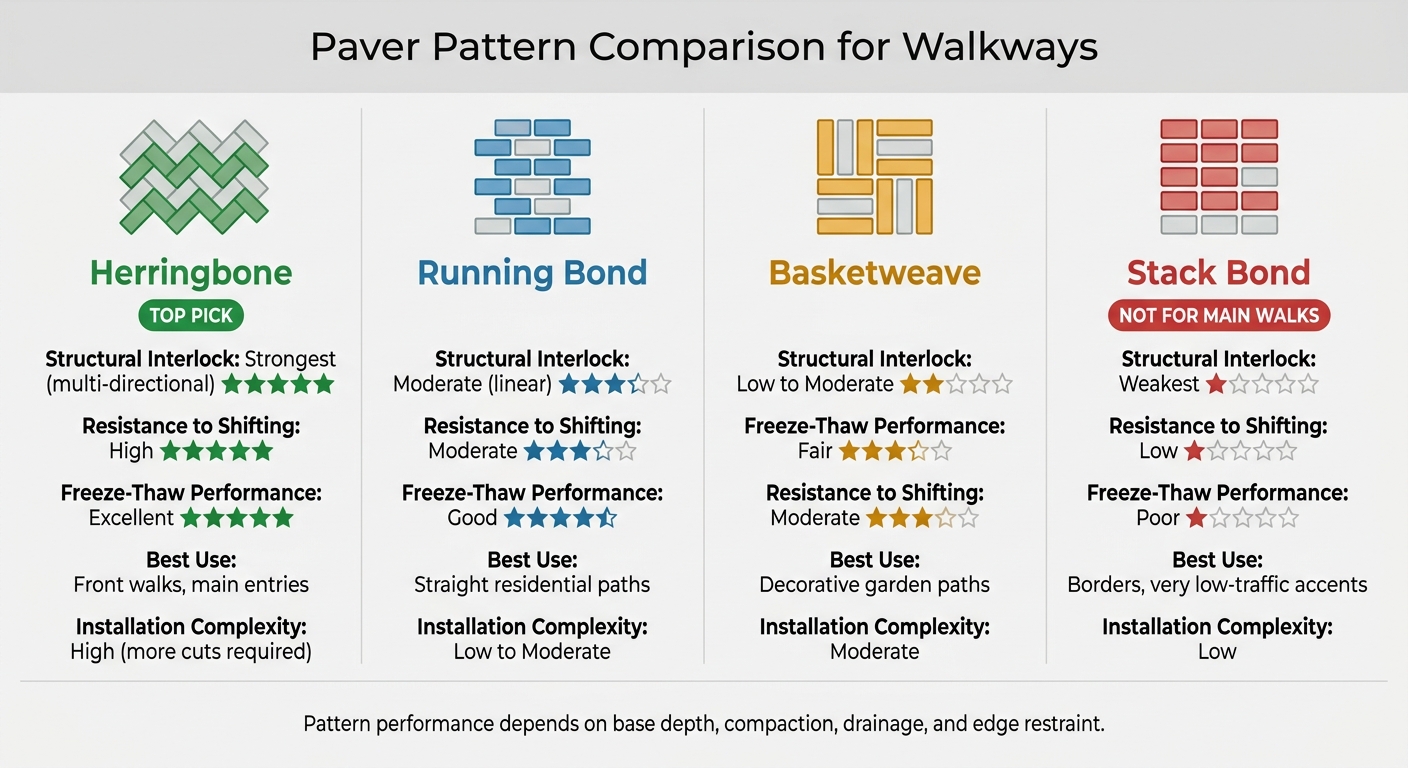
Paver Pattern Comparison: Strength, Stability & Winter Durability
These four patterns behave very differently once a walkway starts dealing with foot traffic, edge pressure, and winter movement. The table below compares interlock, resistance to shifting, and freeze-thaw performance. The big thing to watch is how well each pattern holds the pavers in place.
| Pattern | Structural Interlock | Resistance to Shifting | Freeze-Thaw Performance | Best Use Case | Installation Complexity |
|---|---|---|---|---|---|
| Herringbone | Strongest (multi-directional) | High | Excellent | Front walks, main entries | High (more cuts required) |
| Running Bond | Moderate (linear) | Moderate | Good | Straight residential paths | Low to Moderate |
| Basketweave | Low to Moderate | Moderate | Fair | Decorative garden paths | Moderate |
| Stack Bond | Weakest | Low | Poor | Borders, very low-traffic areas | Low |
Running bond is the simplest pattern in the group, and that simplicity comes with a tradeoff. Its staggered-joint layout offsets each row by half a paver length, which creates some interlock and helps it perform well on straight residential paths.
That said, its weak spot shows up when the walkway gets pushed sideways. Because the joints still follow a mostly straight layout, running bond has less resistance than herringbone under lateral stress. It locks mainly in one direction, so pressure at the edges and movement in the soil can slowly pull joints apart.
Herringbone, laid at 45 or 90 degrees, is the strongest walkway pattern. The angled layout locks in more than one direction, so it does a much better job resisting spread when the ground shifts. That matters a lot in winter. Frost heaving puts real stress on paver joints every year, and herringbone handles that stress better than any other common pattern.
It does take more work to install, especially along the edges where more cuts are needed. Even so, for a main front walk or any entry path that gets regular use, that extra effort pays off. It keeps its alignment better through seasonal movement.
These two patterns lean more toward appearance than structure.
Basketweave can work on low-traffic paths, but it gives up stability compared with herringbone. Its interlock is limited, so it fits best in garden or decorative areas where the walkway does not need to handle much stress.
Stack Bond has a much bigger structural weakness. Its joints run in straight lines both vertically and horizontally, with no offset at all. So there is almost no structural interlock between pavers. Once movement starts, the pattern has very little holding it together. Gaps can open, pavers can shift, and the surface can turn uneven over time. It makes more sense for borders and very low-traffic accents than for a walkway people use often.
Pattern performance matters most when it lines up with what the path needs to do. The earlier comparison covered strength. Here, the focus is where each pattern makes sense. The best pick comes down to foot traffic, weather exposure, and freeze-thaw movement.
Front entry walks handle the most day-to-day foot traffic, so stability comes first. Herringbone is the top pick for front walks because it helps lock the surface in place and resists shifting.
Side paths that run from the driveway to a backyard or gate are a good fit for running bond when the route is straight. It works best on straight paths with moderate use.
Garden walkways are a natural fit for basketweave when the path is mostly decorative and gets light foot traffic. Stack bond works better for accents, not for walkways people use all the time.
A pattern may look great and still be the wrong choice if the path needs more strength than style. Stack bond is the clearest case. In a region with seasonal ground movement, it is more likely to shift. That can lead to open joints, uneven pavers, and trip hazards.
The same idea applies to any pattern installed on a slope or in an area with drainage issues. On sloped or wet sites, pattern choice has to work with the base and drainage plan. Even the right pattern can fail without a solid base, edge restraint, and proper drainage.
Choosing the right pattern helps. But it won’t save a walkway that sits on a weak base. In the Merrimack Valley, freeze-thaw cycles put a lot of stress on paver walkways, so what’s under the surface matters just as much as what you see on top.
The installation details that most directly affect long-term walkway performance are base depth, compaction, edge restraint, and drainage. Each one plays a big role in keeping pavers steady through New England’s seasonal ground movement.
A compacted aggregate base helps pavers stay stable as the ground shifts with the seasons. That’s what keeps even a strong pattern from breaking down too soon.
Drainage matters just as much. When water collects under or around a walkway, it can add to seasonal movement and erosion. The walkway’s slope, along with the nearby landscape, should carry water away from the surface, not toward it. If a property already has drainage issues, that has to be built into the plan from day one.
Accurate grading and solid edge restraint help stop settling and spreading. Once the base, drainage, and restraint are set up the right way, pattern choice becomes the last performance call.
Site conditions vary across the Merrimack Valley, so pattern selection should come after a site review. Oliver Enterprises looks at each property’s grade and soil conditions before recommending a layout.
"Concepts evolve into clear plans, with thoughtful details that balance beauty and function." - Oliver Enterprises
That site-first approach matches the pattern to the grade, soil, and drainage before installation starts. From there, the pattern choice follows the conditions on the ground, which leads into the next section.
When you weigh pattern strength against site conditions, the ranking gets clear. For Merrimack Valley walkways, herringbone is the most durable pattern because it handles shifting and freeze-thaw stress better than the others. Locked joints keep the surface even over time, and that's what matters most in a cold-climate install.
Running bond and basketweave can work well for lower-stress walkways when the base is solid and drainage is handled correctly.
Stack bond is the least durable option. No offset joints means more movement during freeze-thaw cycles, which makes it a poor fit for primary walkways or high-traffic areas.
Oliver Enterprises applies that hierarchy on paver projects across North Andover, matching pattern to traffic load and site conditions before any design decisions get made. Pattern choice needs to match climate and installation quality — even the strongest pattern can fail on a weak base. Structure comes before appearance, which means pattern selection is a structural decision first and a design choice second. That's what separates hardscaping that holds through a Massachusetts winter from work that starts asking for repairs by spring.
Herringbone is often seen as the most structurally reliable pattern for a sloped walkway. Its interlocking V-shape forms a mechanical bond that helps resist shifting from foot traffic and gravity on an incline.
It also spreads pressure more evenly across the surface, which helps keep pavers from sliding or loosening over time. With proper base prep and compaction, it offers strong, lasting stability.
Yes. The shape of a paver - and the pattern you lay it in - can affect how strong a walkway feels over time, especially in freeze-thaw climates like North Andover’s Zone 6b.
Interlocking concrete pavers are built to handle small shifts in the ground because the joints give them a bit of flex. But that doesn’t mean any shape or pattern will perform the same way. A walkway stays stable when the pavers lock together well and spread pressure across the surface instead of letting pieces drift out of place.
Good concrete matters too. But long-term performance comes down to the full setup: tight interlock, precise base prep, and proper drainage. If the base is off or water has nowhere to go, even strong pavers can start to move as the ground freezes and thaws.
Prevent shifting with a solid base, edge restraints, and good drainage. Start by excavating to the right depth. Then add 6 to 8 inches of compacted crushed aggregate base, installing it in 3-inch layers.
Next, secure heavy-duty plastic or aluminum edge restraints into the compacted base. Fill the joints with polymeric sand, and keep a slope of at least 1/4 inch per foot so water drains away from the surface.