Compare wood and composite decking in Massachusetts—cost, maintenance, moisture resistance, and lifespan to choose the right material.
If you want the short answer: wood costs less at the start, while composite usually lasts longer and needs less work in Massachusetts weather.
Massachusetts gets 60+ freeze-thaw cycles a year, and that puts extra stress on deck boards, fasteners, and framing. For most homeowners, the choice comes down to upfront price, upkeep every few years, moisture resistance, and how long the deck needs to last. Pressure-treated wood is often the lowest-cost path now, but composite can make more sense if you want less maintenance and plan to stay put for 15+ years.
Here’s what matters most:
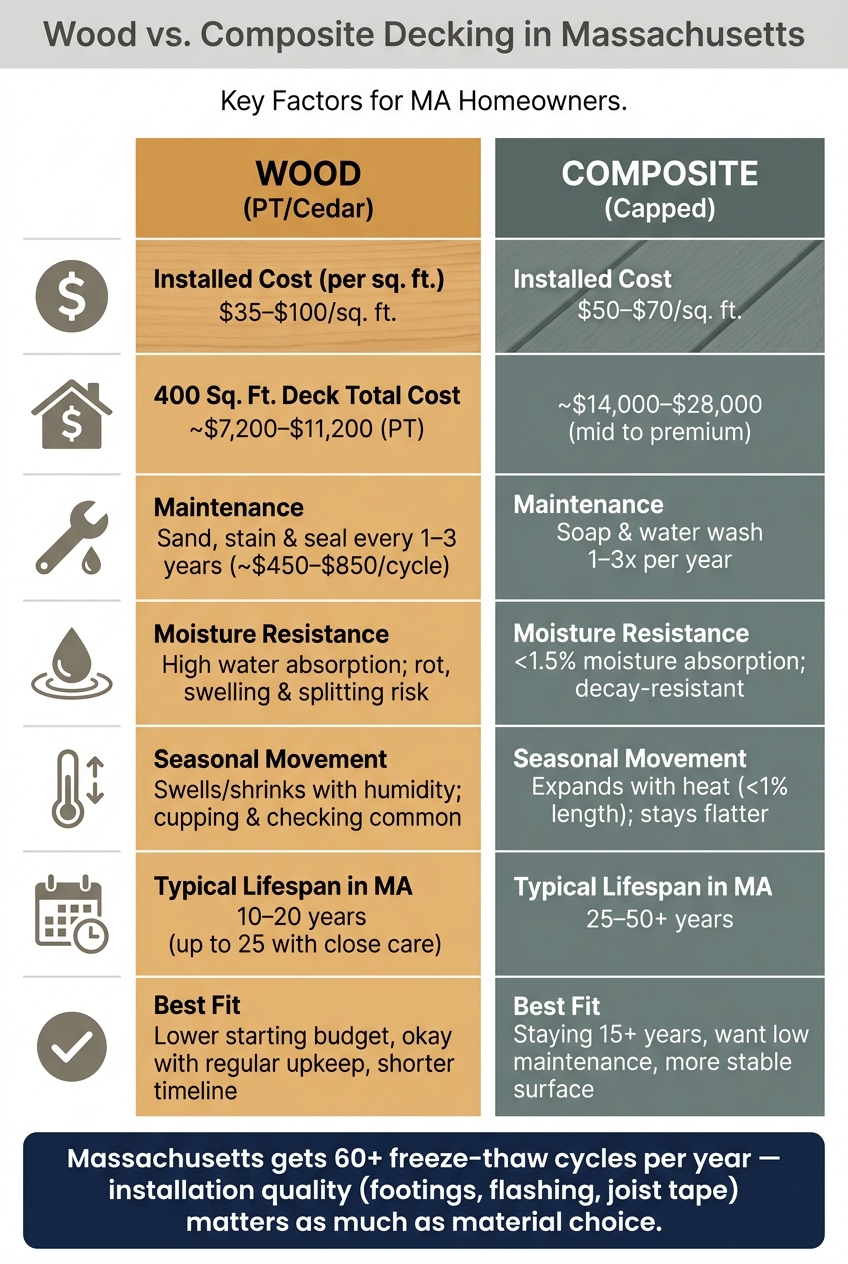
Wood vs. Composite Decking in Massachusetts: Cost, Maintenance & Lifespan
| Factor | Wood (PT / Cedar) | Composite (Capped) |
|---|---|---|
| Installed cost | About $35 to $100/sq. ft. | About $50 to $70/sq. ft. |
| 400 sq. ft. deck cost | About $7,200 to $11,200 for PT wood | About $14,000 to $28,000 depending on grade |
| Maintenance | Sand, stain, seal, inspect | Wash with soap and water |
| Service life in MA | About 10 to 20 years | About 25 to 50+ years |
| Moisture handling | Absorbs water; more rot and split risk | Low water uptake; better in winter |
| Seasonal movement | Swells and shrinks with moisture | Expands and contracts more with heat |
| Best fit | Lower starting budget, wood look, okay with upkeep | Longer stay, lower upkeep, more stable surface |
One more point: installation quality matters just as much as the board choice. In Massachusetts, details like frost-depth footings, ledger flashing, joist spacing, corrosion-resistant hardware, and joist tape can shape how long the deck holds up.
The rest of this guide breaks down where wood saves money, where composite earns its higher price, and which option fits your home, budget, and timeline.
Wood is cheaper to put in at first. But over time, it asks for more work and more money. So the big tradeoff is simple: do you want to spend less now and do more later?
Pressure-treated (PT) pine is usually the lowest-cost decking surface, with installed prices in the Massachusetts market ranging from $35 to $65 per square foot. It also goes in faster than denser hardwoods, which helps keep labor bills lower.
Move up to cedar or mahogany, and installed costs usually land around $50 to $100 per square foot. Dense hardwoods sit at the top end, often costing $90 to $130 per square foot installed. It’s still wood, just at the premium end of the range.
One item that often slips past homeowners is fastener hardware. Modern PT lumber uses copper-based preservatives like ACQ or CA, and those treatments can eat away at standard zinc-coated screws and bolts. So stainless steel or hot-dipped galvanized hardware needs to be part of the budget from day one - not some nice-to-have add-on.
In Massachusetts, wood decks usually need sanding, staining, and sealing every 1 to 3 years, depending on the wood species and how much sun and weather the deck takes on.
For PT pine, that often means sealing or staining every one to two years. Cedar gives you a bit more breathing room, usually every two to three years, but it still needs regular care. Hiring out the work for cleaning, sanding, and sealing usually costs about $450 to $850 per maintenance cycle.
And that’s only part of the job. Wood decks also need routine checkups. Fasteners can back out as boards swell and shrink. Snowmelt can reveal soft spots. Some boards may cup or crack and need replacement.
Decks with southern exposure take harder UV wear and often need refinishing sooner. If the wood doesn’t have UV protection, it can turn silver-gray in just two to four seasons.
How long a wood deck lasts depends a lot on how well it’s cared for. In Massachusetts, neglected wood tends to wear down fast.
PT pine typically lasts 10 to 15 years in this climate, and careful upkeep can stretch that to 25 years. Cedar usually does a bit better, with an average life of 15 to 20 years. Dense hardwoods can last 25 years or more, though they still need periodic oiling to limit surface fading.
Freeze-thaw cycles are hard on wood. Moisture gets in, then expands as it freezes. That leads to checks, cupping, and rot. Miss even one maintenance cycle, and that wear can speed up in a hurry.
Spring is the right time for an inspection. Look for corrosion on hardware, probe boards for soft spots, and clear away debris that held moisture through winter. That upkeep load is a big reason many homeowners start weighing wood against composite next.
Composite moves more of the cost to the start of the project. You pay more at installation, but you usually spend less time and money on routine upkeep later. In Massachusetts, that tradeoff stands out because freeze-thaw cycles are hard on boards that hold moisture.
Compared with wood, composite moves cost from upkeep to installation. The boards cost more to make because they're engineered from recycled wood fibers and plastic polymers, and many products include a protective cap or shell.
Installation widens the price gap too. Composite flexes more than wood, so deck builders often tighten framing to 12 inches on center instead of 16. That tighter framing helps support the boards and cuts down on bounce. The result is simple: more joists, more labor, and a higher bill before the first board is installed. Many composite projects also use hidden fastener systems. They give the surface a cleaner look, but they usually take more time to install.
For a standard 400-square-foot deck in the Massachusetts market, the installed cost usually looks like this:
| Material Tier | Estimated Installed Cost (400 sq. ft.) |
|---|---|
| Pressure-Treated Wood | $7,200 – $11,200 |
| Mid-Grade Composite | $14,000 – $20,000 |
| Premium PVC / Capped Composite | $20,000 – $28,000 |
Capped composite takes in far less moisture than wood, which helps it resist freeze-thaw cracking and warping during Massachusetts winters. Premium boards also stay flexible in subzero temperatures.
That said, product grade makes a big difference. Budget composite, especially uncapped boards, leaves wood fibers open to moisture and UV exposure. Cheaper boards may show clear wear within 8 to 12 years, while premium capped boards often come with 25- to 50-year warranties. In coastal areas like Cape Cod and the South Shore, PVC is often a better match because it has no wood fiber for salt air and moisture to wear down.
Lower upkeep doesn't mean no upkeep.
"Low-maintenance does not mean no-maintenance. A simple cleaning once or twice per year is often sufficient to maintain appearance." - Bradley's Building Solutions
A soap-and-water wash two to three times a year takes care of most cleaning needs. The main thing to watch is debris collecting in the gaps between boards. When that debris sits there, it holds moisture and can lead to mold or algae in shaded areas.
Pay close attention to stairs, railing posts, and any section that stays wet through the winter. Those spots tend to hold snow longer, which means moisture sits there longer too. Composite can also get slippery when icy, so boards with embossed or brushed textures are worth specifying for stair treads.
Massachusetts weather is tough on decks. Rain, snow, freeze-thaw cycles, and humid summers all take a toll. The big difference comes down to how wood and composite deal with water and seasonal movement.
Moisture is the main stress test.
Wood takes in water. Then winter hits, that water freezes, the boards swell, and cracks can start to show. Over time, that cycle can wear wood down fast.
Capped composite takes in far less moisture, so it stands up better to those kinds of failures.
That said, most composite decks still sit on a pressure-treated wood frame. So even if the deck boards hold up well, the framing still needs protection. Joist tape or flashing can help protect the substructure.
Water is only part of the issue. Temperature swings change how each material acts too.
Wood reacts mostly to moisture. It swells when humidity goes up and shrinks when it drops. Repeat that cycle enough times, and you can end up with cupping, twisting, and warping within 24 months on an unmaintained deck.
Composite moves mostly because of temperature. High-end capped boards expand less than 1% of their length in summer heat. That helps the surface stay flatter and more even over time.
There is one catch: composite needs the right gap spacing during installation. If boards go in too tight during cool weather, they can buckle once summer heat rolls in.
| Feature | Wood (PT / Cedar) | Composite (Capped) |
|---|---|---|
| Upfront Cost (installed) | $35–$100 per sq. ft. | $50–$70 per sq. ft. |
| Routine Maintenance | Staining and sealing, plus inspections | Wash 1–3 times per year |
| Moisture Response | High absorption; rot, swelling, splitting risk | Less than 1.5% absorption; decay-resistant |
| Seasonal Movement | Significant; cupping and checking common | Minimal; less than 1% length expansion |
| Typical Lifespan (MA) | 10–20 years depending on upkeep | 25–50+ years |
That gap is what drives the next part of the choice: your budget, how much upkeep you want to deal with, and how long you plan to stay.
Once you’ve ruled out moisture and movement issues, the choice gets more practical: What can you spend now, how much upkeep are you willing to deal with, and how long do you want the deck to hold up? In Massachusetts, freeze-thaw wear puts extra pressure on that decision.
Pressure-treated wood is usually the lowest-cost option upfront. But there’s a catch. It makes sense only if you’re okay with repeat maintenance - sanding, staining, and sealing on a regular cycle that usually runs $450 to $850 each time. Skip that work, and Massachusetts winters can wear the deck down faster.
Composite makes more sense if you expect to stay 15 years or longer and don’t want to keep up with that repeat maintenance. The install price is higher at the start, but ongoing care is limited, so the math can shift in its favor over time. If your main goal is a more natural wood appearance, cedar is often a good fit.
Picking the right material is only part of it. The deck also has to be built for local weather and soil conditions. In Massachusetts, that means frost-depth footings, proper ledger flashing, and, with composite, tighter joist spacing plus joist tape on a wood frame.
Installation quality can matter just as much as the material itself. Oliver Enterprises works as a deck builder in North Andover with those site conditions built into the process from the start. That's often the line between a deck that holds up and one that starts asking for repairs too soon.
Composite decking usually costs less in the long run.
Wood is cheaper at the start. But in Massachusetts, it needs regular sanding, staining, and sealing to help stop rot, mold, and warping.
Those yearly wood upkeep costs - about $450 to $850 - can shrink the gap over 25 years. Composite, on the other hand, usually needs little more than the occasional wash and can last 25 to 50 years.
That’s why composite often pays for itself within about a decade.
Yes. Composite decking is often worth it for Massachusetts winters because it takes in far less moisture than wood. That matters when temperatures swing above and below freezing. Less trapped water means a lower chance of splitting, cracking, or warping during freeze-thaw cycles.
It usually costs more upfront. But over 25 years, it can save money because you skip the yearly sanding, staining, and sealing that wood needs.
In Massachusetts, the main deck issues come down to freeze-thaw cycles and humidity. Wood tends to soak up moisture, and when that moisture freezes, trouble starts: cracking, cupping, and rot can follow.
Composite handles moisture much better, which makes it a stronger fit for these conditions.
No matter which surface material you choose, the footings should extend below the frost line - typically 48 inches - to help prevent shifting.