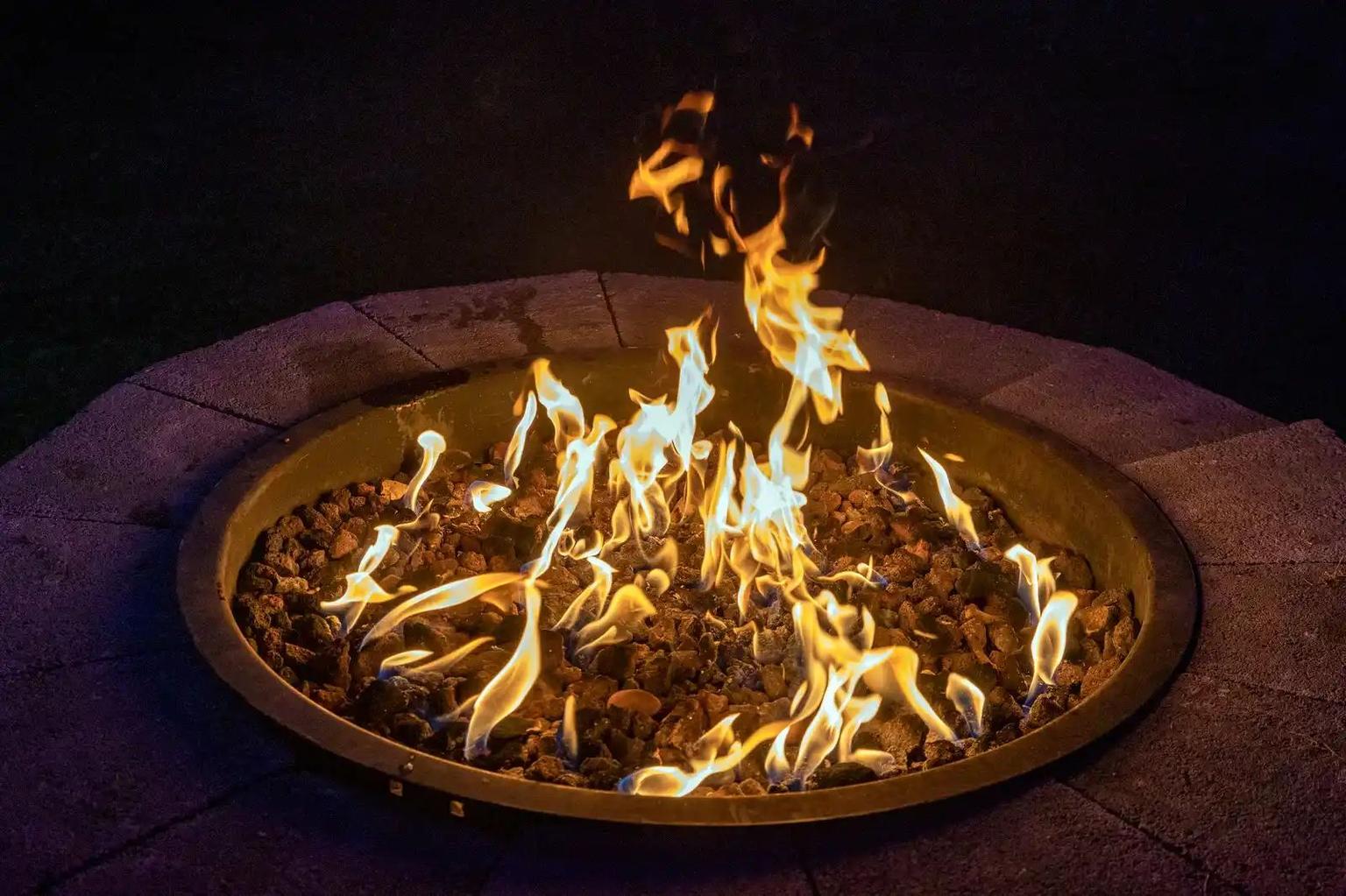
Avoid wood-burning fire pits on wood decks; propane may be allowed only if the exact model, required clearances, deck load, and local rules all allow it.
Keep wood-burning fire pits off your wood deck. Use a level, noncombustible ground-level surface instead; North Andover requires at least 25 feet from structures or combustible materials and no roof, canopy, or overhang above it.
Propane produces fewer sparks and embers, but less ember risk does not mean safe deck use. Before placing one on your deck, verify all four checks:
<u>A mat or heat shield cannot override these requirements.</u> North Andover’s published ground-level placement rules rule out wood decks; contact its Fire Prevention Office at 978-688-9590 to confirm how they apply to your appliance. Before every use, check fire bans and weather, keep extinguishing equipment nearby, and never leave the fire unattended.

Can a Fire Pit Go on a Wood Deck? Safety Checks
Propane lowers ember risk, but it still requires a safe, code-compliant setup.
| Factor | Wood-burning | Propane |
|---|---|---|
| Fuel type | Firewood | Propane gas |
| Primary deck hazards | Hot ash, shifting logs, sparks, drifting embers, and radiant heat | Flame, heated surfaces, radiant heat, gas leaks, and ignition flare-ups |
| Manufacturer approval | The exact model’s manual must explicitly allow wood-deck use and list any required base or shield | The exact model’s manual must expressly permit wood-deck placement and specify any required base or shield |
| Spark and ember exposure | High; a spark screen reduces but does not eliminate exposure | Much lower; heat and flame can still ignite nearby materials |
| Preferred placement | Level, noncombustible surface at grade | Level, noncombustible surface at grade |
Wood-burning pits carry a high risk from sparks and embers. Propane models put more focus on proper installation, but they don’t eliminate ignition risk.
An ember can settle between deck boards or land under furniture. A shifting log can spill burning material outside the bowl. Even without direct flame contact, radiant heat can scorch wood.
A spark screen reduces ember exposure, but lifting it to add wood can release more embers. The screen also won’t block radiant heat or protect against hot ash during cleanup.
For a wood-burning pit, the safer choice is a level, noncombustible surface at grade. NFPA recommends keeping fire pits at least 10 feet from anything that can burn.
With propane, the focus shifts from sparks to whether the exact unit is approved for deck use.
Check the exact model’s manual for permitted surfaces, clearances, ventilation, and leak-check steps. Manufacturer approval does not override local restrictions.
Before each use, inspect hoses and fittings for damage. Follow the manual’s leak-check, lighting, and shutdown procedures. Gas leaks can flare at ignition and cause a fire or explosion.
Keep furnishings away from flames and hot surfaces. Never use the pit in an enclosed or poorly ventilated space.
If the manual allows deck use, the next checks are clearances, deck condition, and load limits.
Propane is an option only if all four checks pass: the specific model permits wood-deck use, required clearances are met, the deck can support the load, and local rules allow it. If any check fails - or you can’t verify it - keep the fire pit off the deck.
A mat or heat shield does not make a prohibited or unsafe setup safe.
Start with the manual. Confirm that your specific model permits use on wood decking. Check the required clearances beside, above, and below the unit, along with ventilation, propane-cylinder placement, and hose routing.
If approval for deck use is unclear, contact the manufacturer before installation. Use only the manufacturer-approved base or barrier. Don’t substitute mats or pavers.
Measure from the fire pit - or the point specified in the manual - to every combustible surface above and around it. Include decking, railings, siding, fences, furniture, umbrellas, eaves, roofs, awnings, branches, and stored firewood.
NFPA guidance recommends at least 10 feet from anything that can burn. Follow whichever requirement is strictest: the manufacturer’s instructions, local rules, or fire-code requirements. North Andover’s published conditions require at least 25 feet from structures or combustible materials and prohibit recreational fires beneath an overhang, roof, or canopy.
Check that the deck can safely support the load. Inspect boards, joists, beams, posts, stairs, the ledger, fasteners, and connections for rot, cracks, sagging, loose connections, and heat damage. If you can’t verify the framing’s condition, have a qualified deck professional or structural engineer inspect it before use.
Add up the weight of the fire pit, protective base, fuel cylinder, furniture, occupants, and any water or extinguishing equipment kept on the deck. Heavy stone or concrete fire tables can concentrate that weight in a small area.
A protective base adds weight; it does not strengthen the deck. If you can’t confirm the deck’s capacity, keep the fire pit off it.
North Andover’s rules apply even if the manufacturer allows deck use. Before installing or using a fire pit, call the North Andover Fire Prevention Office at 978-688-9590. Share the appliance type, fuel type, dimensions, manufacturer instructions, planned location, and clearances so the office can confirm whether your setup is allowed. Homeowners in Andover and other Merrimack Valley towns must check their own town’s requirements.
North Andover requires fire pits, chimineas, and outdoor fireplaces to sit on a noncombustible surface at ground level, at least 25 feet from any structure or combustible material. They cannot sit beneath an overhang, roof, or canopy. This rules out wood decks. If your location meets these requirements, check whether the setup also falls under the town’s recreational-fire rules.
If the town classifies your use as a recreational fire, the fire cannot exceed 3 feet in diameter and must have a spark screen. A capable adult age 21 or older must attend it until it is fully extinguished. Keep a water supply or extinguisher within 75 feet and within easy reach. Confirm whether these conditions apply to propane equipment, and keep smoke under control.
Open burning has separate permit, seasonal, and distance rules. Ask the Fire Prevention Office how it classifies your planned use and whether you need permission. Do not burn leaves, trash, debris, or treated wood in a fire pit.
Check current local and Massachusetts restrictions before every use, including whether a ban covers propane appliances. Do not use the fire pit in strong or shifting winds or unusually dry conditions. Watch it continuously, and extinguish it immediately if the wind shifts, sparks escape, or smoke spreads. If the fire pit fails any local rule, keep it off the deck and move it to a noncombustible surface at ground level.
If any requirement is unverified, keep the fire pit off the deck. Manufacturer approval, clearances, deck capacity, and local permission must all line up. A mat or heat shield can’t override any of these requirements.
North Andover requires recreational fires on a noncombustible, at-grade surface and prohibits placement under an overhang, roof, or canopy. That rules out wood decks. Local fire officials have the final say on code compliance, while a qualified structural professional should assess the deck’s condition and load capacity.
If the deck fails even one check, use a noncombustible patio or ground-level masonry surface instead. Choose level, stable concrete, brick, stone, or masonry, with enough space to meet both local separation rules and the manufacturer’s clearances. Never use the fire pit during high winds, unusually dry conditions, or an applicable fire ban.
Check the current Massachusetts State Building Code (780 CMR) or contact your local building inspector in North Andover. Work with a professional to assess your deck’s framing and load capacity.
For a new project or major addition, include structural details - such as framing and load capacity - in your permit drawings. Have the appropriate local authorities review them before construction begins.
Local rules and regulations take precedence over manufacturer instructions. If your fire pit manual conflicts with North Andover codes or HOA requirements, follow the stricter standard.
Before installing your fire pit, check permit requirements and setback rules with the North Andover Building Department or your HOA board. If you’re unsure, follow the local authority’s requirements to avoid fines or safety hazards.
Contact your local building inspector or the North Andover Building Department to check whether the current fire ban applies to propane-fueled fire pits. Fire rules and permit requirements vary by town, so local officials are the best source for confirming which fire features are restricted.